
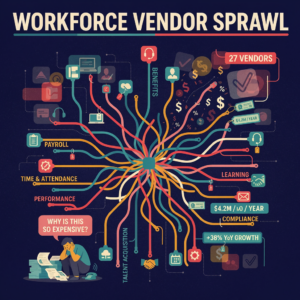
Walk into most mid-market or enterprise operations today and ask who designed the current workforce model. The honest answer is nobody. Hiring managers brought in vendors to solve urgent requisitions. Procurement added vendors to meet rate card requirements. A specific initiative needed a specialized firm. A regional expansion required a local partner. Over time, 6, 10, 15+ workforce vendors are on the panel. None of them chosen as part of a strategy. All of them absorbed into the operation.
The current workforce model at most organizations was not designed. It accumulated. And the costs of that accumulation are showing up in places most executives are not measuring.
The scale of what is actually happening
People2.0’s 2026 State of Contingent Workforce Management Report captured the current state clearly. 46% of enterprises are managing six or more external workforce vendors, and close to one in five are managing more than ten. For 43% of enterprises, contingent workers now represent more than 20% of the workforce.
MBO Partners’ 2026 State of Independence research adds another dimension. A record 74.9 million Americans now earn income independently, and almost 6 million of them earn more than $100,000 a year. The contingent workforce has become a meaningful percentage of how work actually gets done in American business.
Which means decisions about how your organization engages contingent talent are no longer peripheral workforce decisions. They are strategic workforce decisions. The vendor panel you ended up with by accident is governing a meaningful percentage of your productive capacity.
Why vendor sprawl happens, every single time
The drift is predictable. It happens the same way at every organization. A hiring manager hits an urgent need. Procurement does not have time to vet thoroughly. A vendor gets added as a one-off. The vendor stays. Another emergency happens, another vendor gets added. Nobody is responsible for noticing the drift, so it never gets corrected.
This is not negligence. It is the predictable outcome of an uncoordinated series of urgent decisions, each of which made sense in its own moment. The accumulation is where the cost lives.
The hidden costs most executives are not measuring
- Administrative overhead. Every vendor requires contract management, invoicing, performance review, and compliance verification. At the hiring manager level, this gets visceral fast. A hiring manager overseeing contingent workers from 5 different vendors is running 5 different timesheet approval processes, 5 different invoice approval workflows, 5 different performance review cycles, and 5 different escalation paths when something goes wrong. Multiply across every hiring manager in the organization, and the aggregate administrative drag is substantial. This specific pain is one of the real reasons organizations move to MSPs, and the MSP does legitimately solve it. The question is what else gets introduced in exchange.
- Rate confusion. Different rates for similar roles across vendors, no real visibility into what you are paying for comparable work. Fixable by asking for markup transparency directly in the vendor contract. Any staffing partner serious about being a strategic relationship rather than a transactional one will provide it. Vendors who resist markup transparency are telling you something about the relationship they are built for.
- Quality variance. No consistent standard for how candidates are vetted, how placements are managed, how issues get resolved. Candidate quality becomes a function of which vendor you happened to use for that req.
- Context loss. Every vendor starts from scratch understanding your business, your hiring managers, your culture. Multiply that onboarding cost by 10+ vendors and your institutional context lives nowhere. Nobody knows you deeply.
- Compliance risk. Co-employment exposure, worker classification issues, data access, insurance verification, background check standards. Spread across 10+ vendors is a lot more surface area for things to go wrong. The risk is not hypothetical. It usually surfaces at the worst possible moment.
- Opportunity cost. Your most strategic workforce decisions get buried under tactical vendor management. The people who should be thinking about workforce architecture are instead chasing invoices and resolving placement disputes.
The MSP response, and why it often makes the problem worse
he industry’s response to vendor sprawl is to add a layer on top called a Managed Service Provider (MSP). An MSP consolidates vendor management under one portal, standardizes rates, enforces compliance, and promises savings by managing the markups vendors can charge.
EPMA works inside MSP portals today, and we also work directly with clients who engage us as a partner. Same roles, same market, two different structures. What follows is the difference we see from inside both.
In theory this fixes vendor sprawl. In practice, MSPs often make the problem worse. Three specific issues keep showing up.
Problem 1: Quantity over quality
MSPs structurally reward speed-to-submission. Vendors on the panel race to be first with candidates because being first wins the placement. The hiring manager gets flooded with resumes within hours of a requisition opening. Volume looks like responsiveness.
In reality, the vendor race to submit first means less time vetting, less time understanding the actual role, and candidates whose fit was never seriously evaluated. The hiring manager ends up buried in resumes that technically match a job description and do not match the role in practice. The MSP reports high submission volume as a performance metric. The organization experiences it as noise.
Problem 2: The hiring manager and vendor barrier
MSPs sit between the hiring manager and the vendor. Vendors are often not allowed to talk directly to the person doing the hiring. They rely on the MSP to communicate role requirements, team culture, red flags, and calibration feedback after interviews.
Which means the vendor is sourcing against a secondhand description of what the hiring manager actually wants. The nuances that make a candidate the right fit (how they communicate, how they handle ambiguity, how they fit the team culture) do not survive the intermediary. The vendor is working from a job description. The hiring manager is looking for a human. The gap between those two is where good candidates get missed and bad fits get submitted.
Problem 3: The margin-dictation problem
MSPs typically standardize vendor markups across all roles. For companies whose contingent spend is primarily in high-volume, lower-margin categories (skilled trades, light industrial, call center), the standardized markup works. The vendor can hit volume at the dictated margin. The MSP’s math makes sense.
But that same standardized markup applied to professional and specialized roles breaks the model. The vendors who can produce quality candidates for a specialized engineering role, a senior PM, or a technical architect need meaningfully higher margins to justify the sourcing investment. When the MSP dictates the same markup across role categories, the specialist vendors have two options: lower-quality candidates to make the margin work, or decline to participate. Either outcome costs the organization the quality it was supposedly saving money to obtain.
This is especially painful at organizations whose MSP relationship was designed around blue-collar or skilled-trade volume, then extended to cover professional-services hiring. The structure that made sense for one category actively damages outcomes in the other. The company signed one contract, but the contract was really optimized for one kind of hiring. Everything else gets forced through the same structure, and the professional roles are where the quality collapse shows up first.
What a designed workforce model actually looks like
A designed workforce model is not an MSP portal. It is a deliberate workforce architecture built on preferred partners in each category you hire in, selected for depth of fit rather than breadth of coverage. There is no magic total number of vendors. There is a specific right answer per category.
- Preferred few per category. Not a magic total number across the organization. A small, trusted set of partners in each category where you hire regularly. Different categories need different partners. A firm that excels at technical PMs is almost never the same firm that excels at skilled trades.
- Partners selected for category expertise and cultural fit, not just rate card. The right partner for your professional staffing needs is almost certainly not the right partner for your blue-collar needs. Trying to force one firm to do both well is where quality collapses.
- Partners who function as an extension of your recruitment team. They know your business, your hiring managers, and your culture. They have context to vet for fit rather than filter for keywords. They care about quality of placement because their reputation with you depends on it. They talk directly to hiring managers, not through an intermediary.
- Markup transparency built into the contract. Both sides know what is being paid for and why. Removes the information asymmetry that erodes trust over time. A partner who resists this transparency is telling you they are optimizing for something other than the long-term relationship.
- Quality metrics shared and reviewed quarterly. Submission-to-interview ratios, interview-to-offer ratios, retention of placements at 6 and 12 months. Partners worth keeping welcome this review. Partners worth replacing resist it. The data makes the next conversation easier.
- A single workforce planning conversation. One that spans your partners, your permanent hires, your contract workforce, and your internal development pipeline. The partners are part of your workforce strategy, not separate from it.
The diminishing returns of vendor expansion
One of the beliefs driving vendor sprawl is that more vendors means a wider candidate pool, which means better candidates. This assumption deserves direct examination.
The first vendor added to a category gives you access to a candidate network you did not have before. The second vendor adds some incremental access and some overlap. By the third vendor in the same category, the overlap is substantial. By the fourth and fifth vendors in the same category, you are mostly looking at the same candidates from different sources. Candidate networks are not infinite. Good staffing partners largely know each other and often know the same candidates.
Which means after a certain point, adding another vendor stops producing better candidates and starts producing more submissions of the same candidates. The hiring manager cannot tell the difference between 20 unique candidates from 2 strong partners and 20 candidates from 5 partners that are mostly duplicates of each other. The second scenario looks like more volume, feels like more effort, and produces less value.
The point of diminishing returns is real. The suggestion is not to use one vendor. It is to use the right number per category to access the distinct candidate networks that matter, without creating overlap that generates administrative load without adding candidate quality.
The compounding advantage
Operations that redesign the workforce model from a vendor panel into a strategic partner architecture consistently report lower total workforce costs, higher-quality placements, and faster time-to-productivity. The gain is not primarily financial. It is the strategic clarity that comes from having a workforce model you actually designed, with partners who know your business and are accountable to its outcomes.
The organizations stuck in sprawl keep paying the hidden costs. The organizations that moved to MSP-only consolidation often traded one problem for another. The organizations that redesigned the model as a deliberate partner architecture are producing meaningfully better workforce outcomes without more spend.
The bottom line
Six vendors was not a decision. Ten vendors was not a decision. The current workforce model is probably not a decision either. It is an accumulation. Which means it can be redesigned by someone willing to look at the whole picture instead of the next requisition.
Thinking about redesigning your workforce partner model?
EPMA partners with mid-market and enterprise operations as a workforce partner, not a vendor on a panel. We work alongside hiring managers directly, provide markup transparency in every engagement, and focus on quality of placement over speed of submission. If your workforce model is costing more than it should and producing less than it should, we are built for that conversation.
Frequently Asked Questions
How many workforce vendors is too many?
There is no single right number across an organization. The right question is not “how many total” but “how many per category.” A small preferred set of partners in each category you hire in (professional staffing, skilled trades, specialized technical roles) consistently outperforms both a sprawling vendor panel and an MSP-mediated panel optimized for one category. Different categories need different partners.
Doesn’t an MSP solve workforce vendor sprawl?
An MSP consolidates vendor management under one layer but often introduces three new problems: it rewards quantity over quality by structurally pushing vendors to compete on speed-to-submission, it creates a barrier between hiring managers and vendors so the vendors source against a secondhand understanding of the role, and it typically dictates a standardized markup that works for high-volume categories but breaks the economics for professional and specialized hiring. Many organizations trade sprawl for a different problem by adopting MSPs.
What should we ask about vendor markup transparency?
Ask directly for the markup percentage to be documented in the vendor contract. A staffing partner serious about being a strategic relationship rather than a transactional one will provide this without resistance. Vendors who refuse markup transparency are telling you something about the relationship they are built for. Transparency on markup removes the information asymmetry that erodes trust in long-term workforce partnerships.
Why does one MSP markup not work across all role categories?
High-volume categories such as skilled trades, light industrial, and call center support lower-margin economics because the vendor can source and place quickly at scale. Professional and specialized roles such as senior PMs, specialized engineers, and technical architects require meaningful sourcing investment to find candidates who actually fit. When MSPs apply a single standardized markup across all categories, specialist vendors either compromise candidate quality to make the margin work or decline to participate. Organizations that use MSPs designed around blue-collar volume often see professional-role quality collapse when the same contract is extended to those hires.
What are the hidden costs of workforce vendor sprawl?
The visible cost is the invoice. The hidden costs are administrative overhead across many vendors, rate confusion for comparable roles, inconsistent candidate quality, loss of institutional context because no vendor knows you deeply, compliance risk exposure spread across many vendor relationships, and the opportunity cost of leadership attention being consumed by tactical vendor management instead of strategic workforce planning.
Does more vendors mean a better candidate pool?
Only up to a point. The first few vendors in a category expand your access to distinct candidate networks. By the fourth or fifth vendor in the same category, you are mostly seeing the same candidates from different sources because good staffing partners largely know each other and often know the same candidates. After the point of diminishing returns, additional vendors stop producing better candidates and start producing more submissions of the same ones. The hiring manager cannot distinguish between 20 unique candidates from 2 strong partners and 20 largely overlapping candidates from 5 partners, except that the second scenario carries more administrative load.
What does a designed workforce model actually look like in practice?
A small set of preferred partners in each category where you hire regularly. Partners selected for category expertise and cultural fit rather than just rate card. Direct relationships between partners and hiring managers rather than intermediated communication. Markup transparency documented in the contract. Shared quality metrics reviewed quarterly. And a single workforce planning conversation that treats partners as part of your workforce strategy rather than separate from it.
EPMA is a project management consulting, staffing, and technology firm serving executives, PMO leaders, and mid-market operations leaders across energy, infrastructure, engineering and manufacturing, technology, and professional services. With over 16 years of history in project and portfolio management, EPMA helps clients design governance, measurement, and delivery infrastructure that turns strategy into provable business outcomes.
Sources
- People2.0, “2026 State of Contingent Workforce Management Report” — vendor concentration and contingent workforce composition
- MBO Partners, “2026 State of Independence” — independent workforce size and high-earning independent professionals