
Something is different about mid-market operations in 2026. The cost-cutting playbook that produced reliable efficiency gains for the past three years isn’t producing the same results anymore. The savings have been found. The line items have been scrubbed. The vendor renegotiations have happened. And the leaders running these businesses are starting to admit, out loud, that there isn’t much more left to cut.
Which raises the question that most of them have not yet answered: where does the next efficiency gain actually come from?
The data confirms what mid-market leaders are feeling
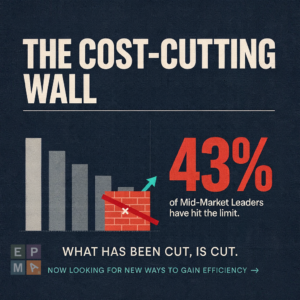
Capital One’s Mid-Year 2026 Middle Market Trends Snapshot captured the shift clearly. 43% of mid-market leaders say efficiency gains from cost-cutting have hit their limit. Only 12% still name cost reduction as a top priority. 47% have moved on to prioritizing top-line growth.
The pattern is clear. The easy cost cuts are done. The remaining question is where the next operating leverage comes from.
Most leaders answer that question by looking at technology. Buy another platform. Pilot another AI tool. Add another SaaS line item. The same Capital One research found 58% of mid-market companies report spending roughly two dollars on technology tools for every one dollar they spend on employee training. The assumption underneath the spend: tools will produce the efficiency gain that cost-cutting cannot.
That assumption is usually wrong.
The contradiction hiding in the same research
The same mid-market leaders funding tool after tool also say that 76% of them consider workforce quality to be their strongest competitive advantage. People, not platforms. Judgment, not software.
Which means mid-market operations are telling themselves one story (people are our advantage) and spending as if a different story were true (tools will drive our next efficiency gain). That gap between stated belief and actual budget is where most of the frustration with 2026 operations comes from. Executives feel like they are investing in productivity, and the productivity isn’t showing up.
The reason is simple. The next efficiency gain is not in the software budget. It is in delivery execution. The specific set of practices that determine whether your organization actually produces the business outcomes it has committed to producing. And delivery execution has no vendor, no SaaS line item, and no procurement champion. Which is exactly why most leaders miss it.
Where delivery execution efficiency actually lives
Delivery execution covers everything that happens between a strategic decision and a measurable business outcome. Scope, staffing, governance, communication, decisions, meetings, and the measurement that tells you whether any of it is working. Each of these is a specific place where mid-market operations are either producing operating leverage or losing it unnoticed.
Seven places the next efficiency gain is sitting right now:
- Planning as an investment, not a formality. Most project failures start in planning rooms where everyone thought they were being efficient. Compressed timelines. Assumptions that never got validated. Execution-level people absent from the room. Lessons from previous projects ignored. Each shortcut taken at planning becomes an expensive crisis in execution. The organizations that treat planning as a real investment (right people, documented assumptions, cross-functional seams designed deliberately) spend less in total because they spend more upfront.
- Portfolio discipline. Resources deployed against the top three strategic priorities, not spread thin across twenty. The willingness to stop a project at month three when it is clearly not working, instead of letting it limp to year-end consuming resources that could be redirected to something that would actually produce value. Most mid-market operations have more active work than their capacity can support, and the lack of discipline about what to stop is where a meaningful percentage of capacity is being wasted.
- Client communication that protects margin. When scope changes or delays happen (and they always do), early transparent communication keeps the client aware and the relationship intact. Documented change orders protect the bottom line from absorbing cost that was never yours to absorb. Most delivery organizations do the opposite: they communicate reactively (when it is already a problem), and they absorb scope creep silently (because having the hard conversation feels harder than eating the cost). Both decisions compound into margin erosion that nobody traces back to the specific moment it started.
- Tool integration and utilization over tool acquisition. Most organizations do not need more tools. They need the tools they already have to be integrated into the actual workflow, used by the people they were bought for, and used correctly. Shadow spreadsheets exist for a reason, usually because the official tool is harder than the workaround. Fixing the integration and training gap on existing tools is almost always cheaper than buying another platform, and the ROI shows up faster.
- Decision velocity. How fast decisions actually get made when they need to be made. Delivery slows most often not because the work is hard, but because decisions are sitting in queues waiting for stakeholders who are overwhelmed or disengaged. Measuring the time from “decision needed” to “decision made” and reducing it deliberately is one of the highest-leverage single changes a delivery operation can make. Decisions sitting in queues cost delivery more than most leadership teams realize.
- Governance that catches problems in weeks, not quarters. Measurement that reflects reality instead of activity. Status reporting that surfaces real risks instead of green-washing them. Executive dashboards that would actually tell you if a project were in trouble, instead of waiting until the finance report at quarter-end makes the problem impossible to ignore. Early detection reduces the cost of the fix by an order of magnitude. Late detection means you are usually paying three times for the same problem.
- Meeting discipline. Fewer meetings, shorter meetings, better-structured meetings with the right people in the room. Every executive complains about meeting load, and almost nobody actually redesigns the meeting infrastructure. The right meetings produce decisions, surface risks, and align teams. The wrong meetings produce agreement that no decision needs to be made, and consume calendar time that should have been producing work. The gap between an operation with good meeting discipline and one without is measurable in productive hours per week per employee.
Why most companies miss this entirely
Delivery execution improvement does not have a vendor. There is no software to buy for “meeting discipline.” There is no procurement process for “decision velocity.” There is no SaaS line item for “client communication that protects margin.” Which means these improvements do not get budgeted the way tools and training do. They do not have internal champions pushing for the next renewal. They require leadership attention, operational redesign, and a willingness to change how work actually happens, all of which are harder than approving an invoice.
The result is predictable. Mid-market operations spend their efficiency budget on the things that have vendors competing to sell them, and leave the places where the real efficiency lives untouched. Then they wonder why the productivity gains do not materialize.
The compounding advantage for operations that make the shift
Mid-market operations that redirect attention toward delivery execution in 2026 will have an operating advantage over operations that keep looking for efficiency in the same places they have always looked. Not immediately. Delivery execution improvements take 6-12 months to compound. But in 2027, when the cost-cutting-only companies hit their next efficiency wall and have nothing left to pull, the operations that have been investing in planning quality, portfolio discipline, communication, tool utilization, decision velocity, governance, and meeting discipline will be running meaningfully leaner for the same output.
That is where the next decade of mid-market operating leverage comes from. Not from more tools. From better execution of the work that is already committed.
The bottom line for mid-market leaders
The next efficiency gain is not buried anywhere exotic. It is sitting in how your organization actually executes the work it has already committed to doing. Which is accessible to any mid-market leader willing to look there, and invisible to any leader still looking in the budget line items the last three years taught them to scrub.
Finding your organization’s next efficiency gain?
EPMA works with mid-market operations leaders to design the delivery execution infrastructure that produces operating leverage after the easy cost cuts are done. If your organization has hit the cost-cutting wall and is looking for where the next efficiency gain actually lives, that is the conversation we help lead.
Frequently Asked Questions
Where does mid-market operating efficiency come from in 2026?
The next efficiency gain is in delivery execution, not in additional cost cuts or additional technology. Capital One’s Mid-Year 2026 Middle Market Trends research shows 43% of mid-market leaders have hit the limit of cost-cutting efficiency. The remaining operating leverage sits in how work gets scoped, staffed, governed, communicated, decided on, and measured. These places have no vendor and no SaaS line item, which is why they usually go unaddressed.
Why are mid-market companies spending more on tools than training?
Capital One’s 2026 research found 58% of mid-market companies report spending roughly two dollars on technology tools for every one dollar on employee training, even while 76% say workforce quality is their strongest competitive advantage. The gap exists because tools have vendors, invoices, and procurement champions pushing their adoption, while training and the delivery execution practices that use those tools well have no internal champion. Budget flows toward whoever is actively asking for it.
What does delivery execution efficiency actually mean?
Delivery execution covers the full set of practices that determine whether an organization actually produces the business outcomes it has committed to. Seven specific places create or lose operating leverage: planning quality, portfolio discipline, client communication and change management, tool utilization, decision velocity, governance that surfaces real risks early, and meeting discipline. Each of these is accessible to any leadership team willing to redesign how work happens.
How do we know if we are losing margin to poor delivery execution?
Common signals include projects consistently running over budget without a clear single cause, change orders that should have been issued being absorbed silently, decisions getting stuck in queues waiting for stakeholders, shadow spreadsheets replacing or supplementing official tools, status reports that always say green until they do not, and executive dashboards that fail to warn you about problems until the quarterly finance review surfaces them. If several of these show up at your organization, delivery execution is costing you more than you currently measure.
Why can’t we just buy a tool to fix delivery execution?
Tools can support delivery execution, but they cannot create it. Project management software does not produce portfolio discipline. Dashboards do not produce decision velocity. Communication platforms do not produce transparent client communication. The practices that create delivery execution efficiency require leadership attention, operational redesign, and sustained behavioral change. The tools help once the practices are in place. The reverse is not true.
What is the highest-leverage first move for improving delivery execution?
Two moves consistently produce the biggest early impact: measuring and reducing decision velocity, the time from “decision needed” to “decision made,” and installing portfolio discipline that stops low-value work earlier. Both free up capacity and attention that was being consumed invisibly. From there, planning quality, communication practices, tool utilization, governance, and meeting discipline compound over 6-12 months.
EPMA is a project management consulting, staffing, and technology firm serving executives, PMO leaders, and mid-market operations leaders across energy, infrastructure, engineering and manufacturing, technology, and professional services. With over 16 years of history in project and portfolio management, EPMA helps clients design governance, measurement, and delivery infrastructure that turns strategy into provable business outcomes.
Sources
- Capital One, “U.S. Middle Market Trends: 2026 Mid-Year Snapshot” — cost-discipline limits, growth prioritization, technology-versus-training spending, and workforce quality as competitive advantage