
You don’t have a dedicated recruiter. You can’t afford a bad hire. And you don’t have time to run the search yourself. Here’s what actually solves that.
Some of the hardest hires I see aren’t at large enterprises with sophisticated talent acquisition functions. They’re at lean executive teams making critical hires without the internal infrastructure most staffing firms assume exists on the client side.
The scenario is familiar. A 40 to 200 person company. No dedicated internal recruiter, or one recruiter who is stretched across the whole company. An executive team that is running the business and now also needs to hire a director of operations, a VP of engineering, a new head of finance, or a senior program leader. The role matters. The cost of getting it wrong is high. And nobody on the executive team has the bandwidth to actually run the process rigorously.
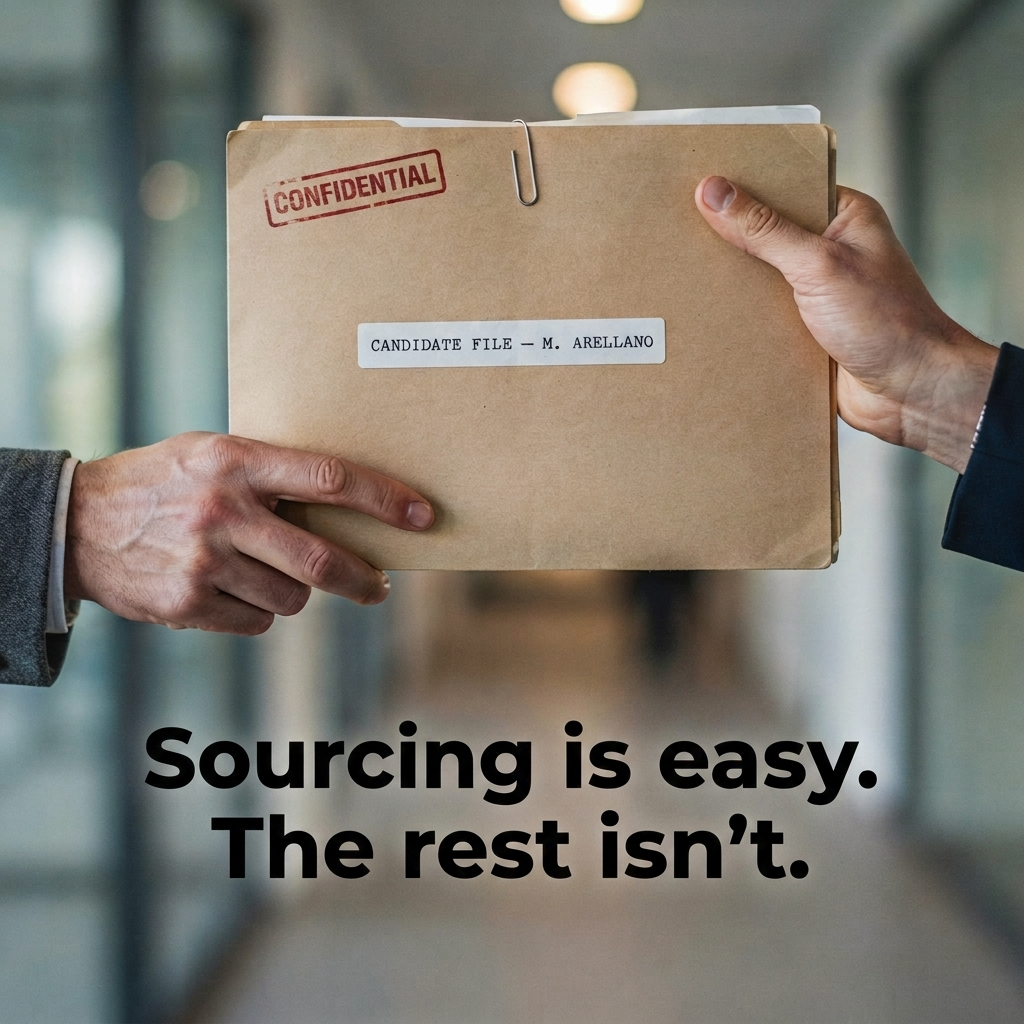
That’s the situation most staffing firms weren’t built to serve. Traditional staffing is built for volume. Take a job description, run a search against a database, submit five or six resumes, and move to the next req. That model works fine when the hiring manager has the internal capacity to interpret the resumes, run the interview process, evaluate candidates against each other, and manage candidate engagement through the timeline. When they don’t, the traditional model doesn’t just underperform. It leaves the executive team holding a job they can’t do well.
What lean teams actually need
When we work with lean executive teams making critical hires, four patterns come up in almost every engagement. These aren’t nice-to-haves. They’re the specific gaps a staffing firm needs to fill for the hire to actually succeed.
- Custom evaluation materials, built for this specific role. Not generic behavioral questions. Actual case studies, technical scenarios, and situational exercises designed around the exact competencies this hire will need in your environment. When a lean team is hiring, they usually don’t have the time or the domain depth to build these themselves. A staffing firm that shows up with a screening kit tailored to the role does a piece of the interview design work that would otherwise fall on the executive team.
- Actual participation in the interview process. Not sending the candidate off and hoping the hiring manager asks the right questions. Sitting inside the interviews, listening to how the candidate responds under real pressure, and providing a trained second set of eyes on the evaluation. This is especially critical for technical or specialized roles where the executive team may not have the depth to fully assess certain answers in real time. It’s also where cultural fit signals often surface, which are almost impossible to catch from resumes or reference calls.
- Structured candidate comparisons. When three finalists all look strong on paper and all interviewed well, the executive team needs a defensible way to decide. Not “who felt right in the room”. A weighted comparison against the criteria that were agreed at the start of the search, with clear articulation of where each candidate is strong and where the risks are. That structure protects the decision from being made on gut feel, and it also protects the exec team politically when they have to explain the pick to their board or their peers.
- Active candidate engagement throughout the entire process. Lean teams have inconsistent process timelines. Something urgent comes up, the search stalls for two weeks, then resumes. Meanwhile, your top candidate is sitting there wondering if they’re still in the running. That’s exactly when they get poached by a competing offer, and it’s the single most preventable loss in executive hiring. A recruitment partner keeps top candidates warm through the delays, manages expectations honestly, and works to prevent the disengagement that turns a first-choice candidate into a lost one.
None of this is groundbreaking. It’s what a functional internal recruiting team would do if you had one. The point is that most staffing firms don’t deliver these things, and lean executive teams are the ones who most need them provided.
Why the traditional staffing model falls short here
There’s nothing wrong with the traditional staffing model in the situations it was built for. High-frequency roles, well-defined requirements, sophisticated internal talent teams who can take resumes and run the rest of the process. That’s a real and important part of the market.
But lean executive teams are structurally the wrong customer for that model. They don’t have the internal machinery to convert a resume submission into a good hire on their own. When the staffing firm assumes they do, everything downstream from the submission suffers. The interview process is thinner than it should be. The comparison decision is fuzzier. The candidate engagement is passive. And the hire is either delayed, wrong, or lost to a competitor who moved faster.
The gap isn’t in candidate quality. It’s in the process infrastructure surrounding the candidate. Traditional staffing firms bring the candidates. Recruitment partners bring the infrastructure too.
What this looks like in practice
We worked with a medical device engineering firm recently that needed to hire a Vice President of Information Technology. The executive team was three people. There was no internal recruiter. The COO had been trying to run the search himself around his day job for four months without a hire that stuck.
The problem wasn’t the candidates. There were qualified people on the market. The problem was that the COO didn’t have the bandwidth to build a rigorous evaluation, sit through multiple rounds of interviews, structure a comparison across finalists, and stay in active contact with top candidates while running the rest of the company. Each of those pieces was getting half of what it needed. And the process kept losing candidates in the middle.
When we came in, the shift wasn’t about sourcing. It was about running the process alongside the executive team. We built custom case studies for the role. We sat in the interviews and provided a written evaluation after each one. We produced a weighted comparison across the final three candidates that gave the exec team a defensible framework to decide from. And we stayed in weekly contact with the top candidate through the two-week delay caused by an internal board meeting, which is exactly the moment the candidate would have accepted a competing offer if nobody had been engaging them.
The hire closed. The COO got his time back. And the executive team ended up with a hire they had genuine conviction on, backed by a process they could point to.
What to look for
If you’re a lean executive team about to run a critical hire, the specific questions to ask a staffing firm before you start will tell you very quickly whether they can actually deliver what you need.
- Will you build custom evaluation materials for this role, or will you rely on standard screening questions? You want the first answer. If they can’t or won’t, the interview design falls to you, which defeats the purpose of engaging a firm.
- Will you participate in our interview process directly? You need a partner who is in the room with you, not one who hands off after submission. This is where the trained second set of eyes actually pays for itself.
- How will you help us compare finalists? The answer should include a structured framework. Not “we’ll help you think it through”. Something you can actually use to defend the decision internally.
- How will you keep our top candidate engaged if our process slows down? This is the question that separates real partners from resume shops. A partner has a plan. A firm has a hope.
- Have you supported a lean executive team through a hire like this before? Can you walk me through what that looked like? Vague answers here are a warning. A firm that has actually done this work can describe the specifics of how a similar engagement ran.
It's not for everyone
Not every hire needs this level of partnership. If you have a mature internal recruiting function, or you’re filling a well-defined role you hire in often, a traditional staffing firm is genuinely enough.
But when the situation is a lean team, a critical hire, a role where the cost of getting it wrong is high, and no internal capacity to run the process rigorously, the choice of firm matters more than most executive teams realize going in. The wrong firm gets you resumes and leaves you to do the rest, which is exactly the situation you engaged them to avoid. The right firm becomes the recruiting function you don’t have, for as long as you need one.
Running a critical hire with a lean team?
EPMA provides embedded recruitment partnership for lean teams making the hires that matter most. Custom evaluation materials, direct participation in your interview process, structured candidate comparisons, and active candidate engagement throughout.
If that sounds like what your next hire actually needs, let’s talk.
Frequently Asked Questions
How do you hire an executive without an internal recruiter?
Bring in a partner who runs the process with you, not one who only sends resumes. Without an internal recruiter, the hard work is everything after sourcing: building an evaluation for the role, running interviews, comparing finalists, and keeping the top candidate engaged. A lean executive team rarely has the bandwidth for all four while running the business.
Why do executive searches stall at smaller companies?
Because the people running the search are also running the company. In a 40 to 200 person company, executives fit the search around their day jobs, so interviews get delayed and follow-up slips. Each part of the process gets half of what it needs, and candidates are lost in the middle. The problem is usually process capacity, not candidate supply.
What should a staffing firm provide to a lean executive team?
Four things: custom evaluation materials built for the specific role, direct participation in interviews, a structured comparison of finalists, and active engagement with top candidates throughout. That is what a functional internal recruiting team would do. When a lean team does not have one, the firm has to fill that gap or the hire suffers.
How do you keep a top executive candidate from taking another offer?
Stay in active contact with them while your process moves, especially through delays. Lean teams have uneven timelines: a board meeting or an urgent issue pauses the search for two weeks, and that is exactly when a strong candidate accepts a competing offer. Regular updates and clear expectations about timing keep a first-choice candidate from becoming a lost one.
Does every executive hire need a recruitment partner?
No. If you have a mature internal recruiting function, or you are filling a well-defined role you hire for often, a traditional staffing firm is enough. The partner model matters when the team is lean, the hire is critical, and nobody inside has the capacity to run the process rigorously.