
Part 3 of the “Beyond the Tool” Series
In the world of project portfolio management, organizations often focus on tracking hours, budgets, and timelines, but fail to measure what truly matters: the deliverables they promised. This oversight is a primary reason why even well-implemented PPM systems ultimately fail. When we prioritize input metrics over outcome measurement, we create a disconnect between organizational activity and actual value delivery.
The Blind Spot in Project Tracking
You’re tracking hours. You’re tracking spend. But are you actually tracking what you promised to deliver?
Most organizations don’t. And that’s where even the most beautifully built project portfolio management (PPM) tools start to fail. When we focus exclusively on inputs and process metrics, we create a fundamental disconnect between the work being done and the value being created.
This disconnect isn’t merely academic, it creates real-world consequences. Teams become frustrated when their meaningful contributions aren’t acknowledged. Stakeholders grow disillusioned when they can’t see tangible progress toward outcomes they care about. And executives make decisions based on incomplete information, leading to resource misallocation and strategic drift.
What’s particularly troubling is how many organizations invest millions in sophisticated PPM systems that perpetuate this problem rather than solving it. These systems often excel at tracking time, money, and task completion, but struggle to connect these metrics to the actual value being delivered.
What Gets Measured Drives Behavior
If your dashboard is all budget burn and timeline status, that’s where everyone’s attention will go. And when a project wraps, someone inevitably asks:
“Did we stay on budget?” “Did we finish on time?”
But the real question is this:
“Did we actually deliver what we said we would?”
Attention follows metrics
Teams naturally prioritize what leadership measures. If deliverables aren’t tracked, they become secondary considerations.
False success narratives
Projects can be labeled “successful” simply because they met budget and timeline targets, even when they failed to deliver promised outcomes.
Eroding system credibility
When PPM systems fail to track what matters most, they gradually lose relevance and credibility within the organization.
Too often, no one can answer that clearly, or worse, the answer is no, but the project is still labeled a “success” because it ticked the right boxes.
That’s how systems become irrelevant. That’s how trust erodes. And that’s how PPM implementations die quiet, expensive deaths. The metrics we choose don’t just reflect our priorities, they actively shape them. When deliverables remain unmeasured, they inevitably become undervalued in the organizational consciousness.
Deliverables: The KPI Most Organizations Ignore
A PPM system should do more than just record what’s been spent. It should give every level of the organization clarity on what’s being built, launched, completed, approved, or handed off — in real time.
Instead, most organizations encounter:
- Dashboards that show financials without context
- Tasks marked “done” but outcomes never validated
- Executive reports that say “on track,” only to reveal critical gaps at go-live
The real problem isn’t tool configuration. It’s metric misalignment. When your measurement system fails to capture the actual value being created, you’re navigating with incomplete instruments.
This misalignment manifests in numerous ways. Project managers focus on keeping activity levels high rather than ensuring those activities produce meaningful outcomes. Leadership reviews become exercises in budget defense rather than value assessment. And perhaps most damagingly, the organization loses sight of why it initiated projects in the first place.
This misalignment manifests in numerous ways. Project managers focus on keeping activity levels high rather than ensuring those activities produce meaningful outcomes. Leadership reviews become exercises in budget defense rather than value assessment. And perhaps most damagingly, the organization loses sight of why it initiated projects in the first place.
Consider a common scenario: A major IT implementation is “90% complete” according to the PPM system. The budget shows only a 5% overrun, and the timeline has slipped just two weeks. By traditional metrics, this project appears to be performing well. Yet when stakeholders begin testing, they discover that three critical functional requirements were deprioritized without clear communication. The project is simultaneously “on track” and failing to deliver what was promised.
When You Don't Track Deliverables, This Happens
Surprises at the Finish Line
“Wait, wasn’t that supposed to be included?” becomes a common refrain when teams reach project completion only to discover misaligned expectations about what was actually promised versus delivered.
Shadow Workflows Emerge
Teams create their own trackers, spreadsheets, and side systems because the official PPM system doesn’t reflect the reality of their deliverables and the actual work being done.
Team-Leadership Disconnect
Teams focus on completing assigned tasks while leadership monitors spend, but no one is effectively measuring whether value is being created or promises kept.
And when leadership doesn’t see deliverables clearly, they fall back on the only metric they can see:
“How much did we spend?”
It’s not that financials don’t matter. They just don’t mean anything without outcomes attached. When deliverables become invisible in your measurement system, the organization loses its connection to purpose. Work becomes an exercise in budget management rather than value creation.
This disconnect becomes particularly problematic in cross-functional initiatives where multiple teams must coordinate their deliverables. Without clear tracking and visibility, integration points are missed, dependencies become obscured, and the cohesive final product fails to materialize despite all individual components appearing “complete” in isolation.
Moreover, the lack of deliverable tracking makes it nearly impossible to conduct meaningful retrospectives. Without clear records of what was promised versus what was delivered, organizations struggle to learn from their experiences and improve their estimation and delivery processes over time.
What You Should Be Measuring
Want your PPM system to feel essential, not optional? Then track what matters. When your system provides genuine visibility into deliverables and outcomes, it transforms from an administrative burden into a strategic asset.
Deliverable Health by Milestone
Track not just if milestones are being hit, but whether the deliverables associated with each milestone are meeting quality and completeness standards.
Completed vs. Committed Scope
Maintain a clear record of what was promised and systematically validate whether each element was delivered as expected.
Progress Tied to Outcomes
Measure advancement not by tasks completed but by progress toward the outcomes those tasks were designed to produce.
Strategic Goal Alignment
Continuously assess whether what you’re delivering remains aligned with the strategic objectives that initiated the work.
Deliverables are the why behind the budget and the timeline. Without them, the rest is just noise. When you center your PPM system around what’s actually being produced, you create a framework that connects daily activities to meaningful outcomes.
This shift requires more than just adding new fields to your system. It demands a fundamental reorientation of how projects are defined, tracked, and evaluated. Success criteria need to be established at the deliverable level, not just at the project level. Progress reporting must include qualitative assessments of deliverable health, not just quantitative measures of task completion.
Organizations that successfully make this transition find that it creates a virtuous cycle. When deliverables become visible, they also become valuable. Teams take greater ownership of their commitments. Leadership makes more informed decisions. And the PPM system itself becomes an indispensable tool for strategic execution rather than a compliance mechanism.
How to Shift the Executive Mindset
Right now, most leadership conversations sound like this:
“How much did we spend?” “How many hours were logged?”
But the shift we need — and the shift PPM systems must enable — is this:
“Are we delivering on what matters?”
That one question reframes the entire narrative. It puts the focus back on value, not activity. Impact, not optics. And it gives your system a reason to exist — because it becomes the source of truth for what’s actually being delivered.
Achieving this mindset shift requires deliberate effort. It starts with changing the conversation in steering committees and status reviews. Instead of opening with budget variance, begin with deliverable status. Make “what did we promise to deliver and where do those deliverables stand?” the first question in every project discussion.
Redefine Success Metrics
Work with executives to establish clear, deliverable-focused success criteria for every major initiative.
Transform Reporting
Redesign executive dashboards to prominently feature deliverable health alongside traditional metrics.
Create Deliverable Visibility
Implement regular deliverable reviews where teams demonstrate progress on actual outcomes, not just task completion.
Connect to Strategic Value
Continuously reinforce how specific deliverables enable strategic objectives and create organizational value.
This Is Why PPM Systems Fail
When systems only track inputs (money, hours, tasks), people stop trusting them. They stop using them. They go back to spreadsheets and side trackers that do reflect the real work.
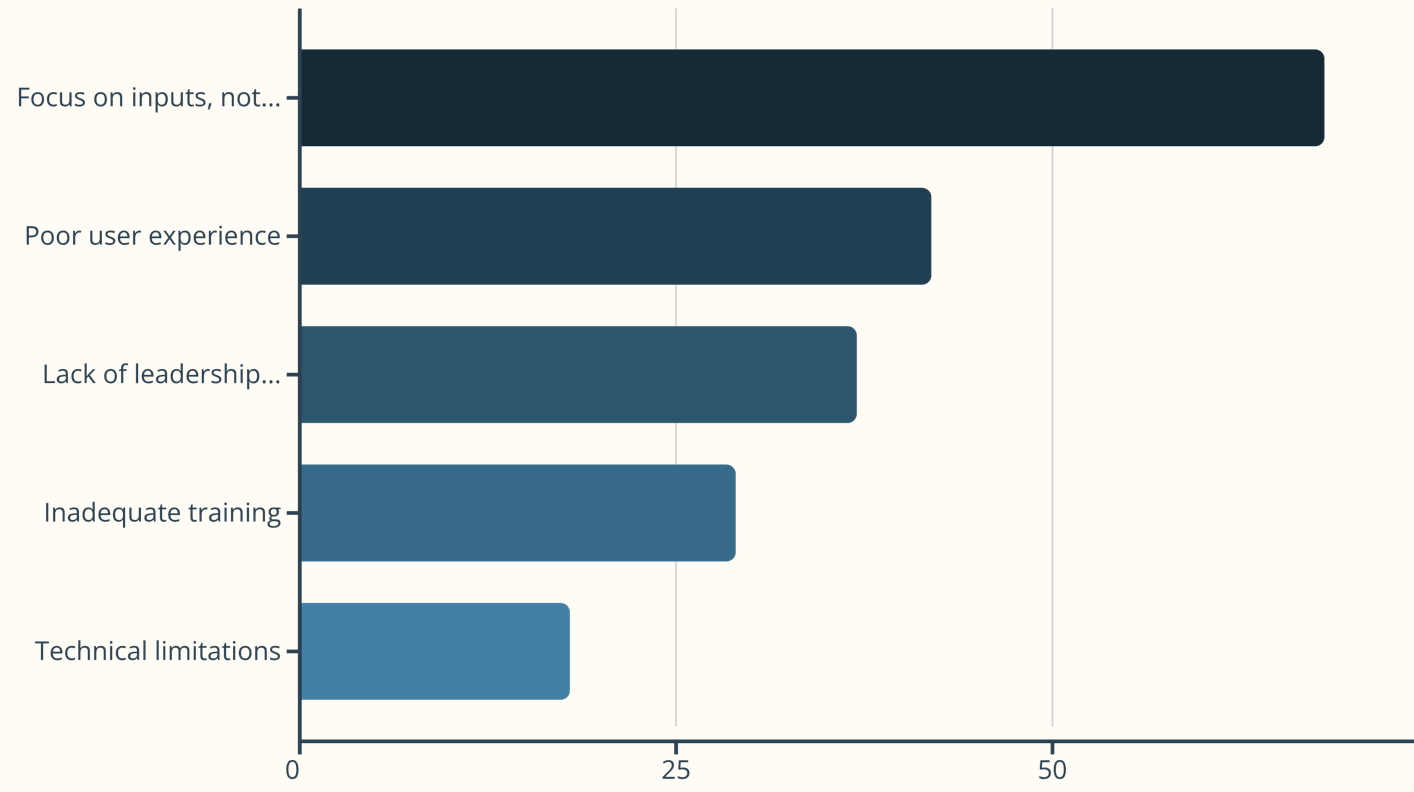
That’s why this article lives in the Beyond the Tool series. Because when the tool doesn’t surface the right story, it gets abandoned — even if it’s technically perfect. The most sophisticated PPM solution will fail if it cannot connect work to outcomes and deliverables to value.
This disconnect creates a predictable pattern in PPM implementations. Initially, there’s enthusiasm and compliance as teams adapt to the new system. But gradually, as the gap between system metrics and actual value becomes apparent, engagement wanes. Teams begin to see the system as an administrative burden rather than a helpful tool. They input the minimum required data, but conduct their “real” work tracking elsewhere.
Eventually, the system becomes a hollow shell—technically operational but strategically irrelevant. Reports are generated but not trusted. Data exists but doesn’t drive decisions. And the organization finds itself with an expensive system that provides little actual value, perpetuating the very problem it was meant to solve.
Breaking this cycle requires more than technical tweaks. It demands a fundamental reorientation around what truly matters: the deliverables that create value. Only when PPM systems center on outcomes rather than inputs can they fulfill their promise as strategic enablers rather than administrative burdens.