
Hiring feels harder than ever in 2026. The natural conclusion is that there’s a talent shortage. Candidates are ghosting. The market is broken. Good people are impossible to find.
None of that is the actual problem.
Applications per open role have roughly doubled since 2022 according to LinkedIn’s 2026 workforce research, driven largely by AI-assisted applying tools that let candidates apply to more roles faster. The pipeline is fuller than it’s ever been. Qualified candidates aren’t scarce. What’s scarce is their patience. And most companies are burning through it before they even realize it.
The bottleneck in your hiring right now isn’t candidate supply. It’s the specific ways your own process contradicts your stated urgency. It’s also not happening in isolation. It sits alongside the workforce trends eroding delivery capacity at most mid-market firms. Here’s exactly where that’s happening.
The moment of contradiction: “ASAP” followed by three weeks of silence
The most common breakdown in mid-market hiring doesn’t happen during the interview process. It happens before the first interview even gets scheduled.
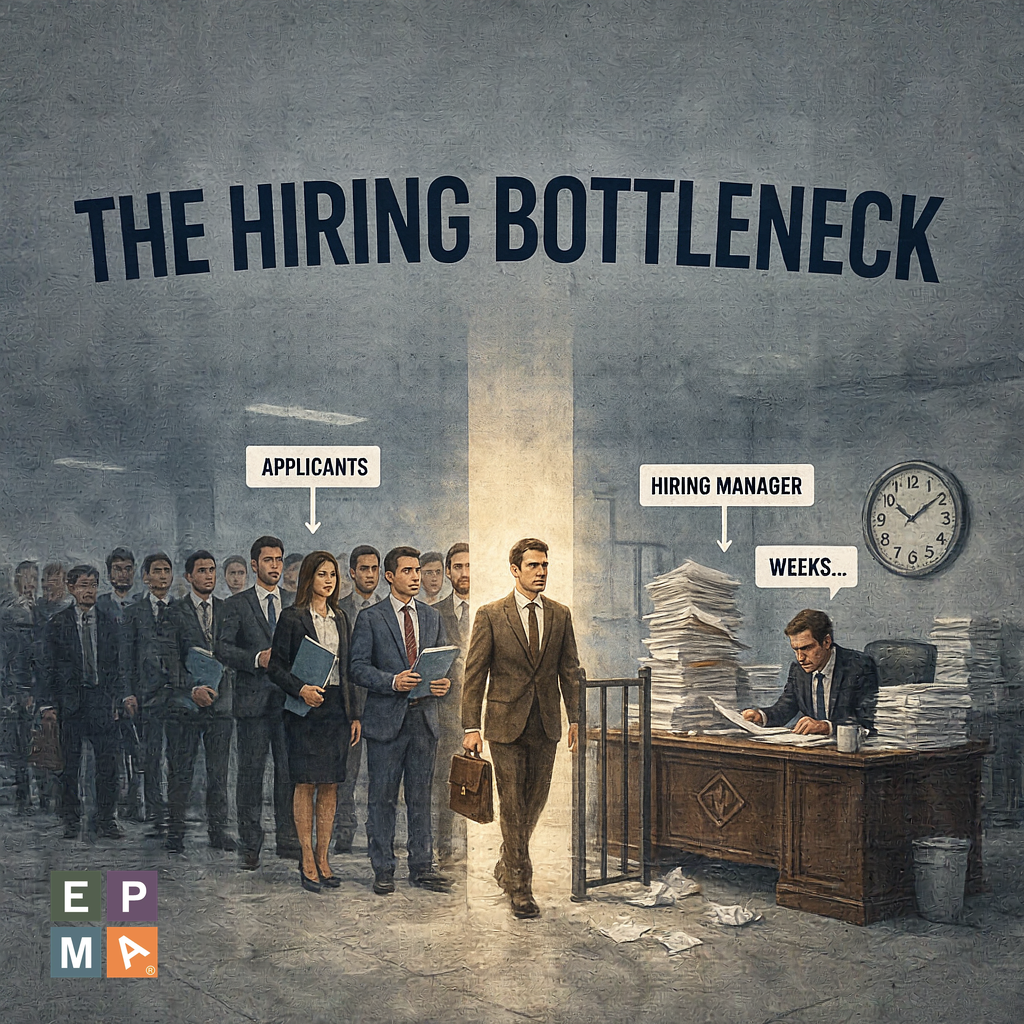
You tell your recruiter or your internal team that this hire is urgent. You need somebody in this seat as fast as possible. Your recruiter surfaces qualified candidates within days. And then days become a week. A week becomes two. The hiring manager is traveling. The panel needs to align on scheduling. There’s an internal debate about whether the role description needs to be updated first. Somebody wants to reconsider the compensation band before you commit.
By the time the first interview finally gets on the calendar three weeks later, your top candidate has already accepted an offer somewhere else. And you’re back at the top of the funnel, telling your recruiter you need somebody in this seat ASAP.
The candidate market has moved. Strong candidates now have three or four active conversations at once, and the offer they take is usually not the best-paying one. It’s the one that moved fastest. When your “we need this person yesterday” turns into three weeks of scheduling limbo, you’re not just losing the candidate. You’re teaching them what it would actually be like to work at your company.
The interview marathon: five rounds of feeling reasonable, ending in a candidate who’s gone
Assuming you actually get the first interview on the calendar, the next problem is the process itself. Multiple rounds. Scheduling drift between rounds. Panel interviews requiring five stakeholders to align on the same 90-minute window. Follow-up conversations to “go deeper” on a specific area. Background checks that take another two weeks after the offer. Budget approvals that need to be re-confirmed.
Each step feels reasonable on its own. Nobody is being unreasonable. The cumulative timeline is fatal. And most of it is invisible to the hiring manager, who sees the individual steps and misses the aggregate elapsed time from a candidate’s perspective.
From the candidate’s side, they interviewed with you five weeks ago and have heard nothing definitive since. They’ve continued their other conversations. They’ve fielded another offer. When you finally come back with your final decision, they’ve already moved on. Not because they didn’t like you. Because your process didn’t treat their time the way you’d expect them to treat yours.
The compare-shopping trap: losing your top candidate while you look for more
This one deserves its own section because it’s the specific mistake we see most often with clients who genuinely want to make good hiring decisions.
You find the right person early in the search. You know it. Your panel knows it. The candidate is technically strong, culturally aligned, appropriately experienced, and enthusiastic about the role. Every honest signal says “make the offer.”
And instead you decide to interview three more people. For comparison. To make sure you’re not settling. Because it’s good practice. Because your board expects a thorough process.
Two weeks later, you’ve confirmed what you already knew: the first candidate was the best of the group. You reach out to extend an offer. They’ve accepted something else.
What that behavior communicates to the top candidate matters as much as the outcome. They watched you delay an offer to someone you already knew was right. Even if they hadn’t taken another offer, they now know something about how you make decisions. They’re less enthusiastic when they finally hear from you. Sometimes the offer they eventually accept from you doesn’t stick, because the process itself planted a doubt.
Comparing is not the same as validating. If you know who the right hire is, comparing more candidates doesn’t make the decision stronger. It just delays it while the market catches up.
The recruiter blindness: not sharing your timeline with the people managing your candidates
If you’re working with an external recruiter or staffing partner, one of the most consistent gaps in mid-market hiring is that clients don’t share their real internal timeline with the firm managing the candidate relationship.
You know that your CFO is out for two weeks. You know the panel can’t align on interviews until after the quarterly board meeting. You know there’s a hiring freeze conversation happening that might delay the offer even if the candidate is perfect. Your recruiter doesn’t know any of that. Which means they can’t prep the candidate for what’s coming. They can’t set realistic expectations. They can’t say “the process is going to slow down for two weeks, hold tight.”
What the candidate experiences instead is silence. And silence in a hot candidate market gets interpreted as disinterest, deprioritization, or a slow-moving company. That’s not what’s actually happening. But without transparent communication with your recruiter, that’s what the candidate concludes. And they start looking elsewhere.
This is a partnership failure, not a candidate failure. It’s also the clearest line between a staffing firm and a recruitment partner: a vendor fills the req, a partner manages the candidate through your timeline. The fix is trivial. Tell your recruiter what’s actually happening on your side. They will manage the candidate through it. Recruiters lose candidates when they can’t communicate honestly with them about timeline. They keep candidates when they can.
The damage isn’t just the candidate you lost
The obvious cost of a slow hiring process is that you lose the specific candidate you were trying to hire. That cost is real and quantifiable, and most hiring leaders can name a recent example.
The less obvious cost is what happens to your employer brand in the candidate community. Every candidate who goes through your slow process talks to others in their network. Every dropped candidate tells at least two or three peers about the experience. Recruiters compare notes across firms about which clients are slow and which are decisive. And by the time you’re searching for your next executive hire, a portion of the candidate market has already decided you’re not worth interviewing with. They just don’t apply.
You never see this cost show up on a dashboard. It looks like a slightly weaker candidate pool six months later. It looks like recruiters being less enthusiastic when you engage them. It looks like your best candidates “not being available.” What’s actually happening is that your reputation for being slow has preceded you. And employer brand damage takes years to repair.
What good hiring speed actually looks like
Fast hiring isn’t about cutting corners. It’s about respecting your own stated urgency and treating candidate time the way you’d expect them to treat yours. Some of the things the fastest hiring teams do differently:
- Sponsor alignment before the first interview, not after. All the internal debate about role definition, compensation, and reporting structure happens before the recruiter surfaces the first candidate. Not after you meet someone you like.
- First interviews scheduled within one week of candidate submission as policy. Not aspirationally. As a rule. If your calendar can’t accommodate that pace, the hire probably isn’t as urgent as you claimed.
- Batched interview rounds instead of sequenced ones. Get all the panel members together on the same day when possible. Every gap between rounds is a place for your process to lose momentum and for candidates to lose interest.
- Decision authority at the hiring manager level. The hiring manager should be able to extend an offer without a five-person approval chain. If your process requires more, the offer approval workflow needs to be pre-negotiated before the search starts.
- Transparent timeline communication with your recruiter. Your external recruiting partner is on your team. Tell them what’s actually happening internally so they can manage candidate expectations honestly.
- Make the offer when you know it’s the right hire. Not after two more comparison interviews. If you know it’s them, don’t give the market time to take them from you.
What to actually measure
Most hiring dashboards measure the wrong things. Time-to-fill and cost-per-hire are useful, but they don’t catch the specific process failures that cost you the candidates you actually wanted. Better metrics to build a view around:
- Time from candidate submission to first interview scheduled. If this is more than one week, this is your first failure point.
- Time from first interview to offer extended. For most roles, more than three weeks here is death.
- Time from offer extended to candidate acceptance. If this drags, your offer package or your process communication is the problem.
- Rate of top candidates lost to competing offers. If more than one in three of your top choices takes a competing offer during your process, your speed is the reason.
- Candidate NPS on your hiring process. Ask candidates who did NOT accept your offer what their experience was like. Their answers will tell you what your brand looks like in the candidate community.
Fast hiring isn’t about cutting corners
It’s about aligning what you say about urgency with what your process actually does. The companies that hire the candidates they want are the ones whose behavior matches their stated priorities. The companies that keep losing top candidates are the ones whose process contradicts their own urgency, and who blame the market for the result.
The hiring bottleneck in 2026 isn’t a talent shortage. It’s a process problem. And it’s fixable.
Kaly Samadi is President & CCO of EPMA, a project management consulting, staffing, and technology firm. EPMA works with project-driven organizations to run searches that keep strong candidates engaged from first submission through signed offer.
Sources
Fortune, How hard is it to get hired right now (January 2026), citing LinkedIn’s 2026 survey of 19,113 consumers and 6,554 HR professionals
Losing top candidates in your process?
EPMA works as a recruitment partner for organizations navigating these exact challenges. We keep candidates engaged through your process, manage expectations transparently, and give you a partner who understands what your candidates are hearing while you’re making decisions internally.
If you have a critical hire in front of you and want a real partner in the search, let’s talk.
Frequently Asked Questions
What causes a hiring bottleneck when qualified candidates are available?
Usually your own process. Strong candidates often have three or four active conversations at once, and the offer they take is frequently the one that moved fastest, not the one that paid most. Scheduling delays, long gaps between interview rounds, and extra comparison interviews give competing employers time to close first.
How fast should we schedule a first interview?
Within one week of a candidate being submitted, as a policy rather than an aspiration. The gap between submission and first interview is where the most common breakdown happens: the role is called urgent, qualified candidates arrive within days, and then scheduling drifts for weeks. If your calendar cannot support that pace, the hire may not be as urgent as the request suggested.
Is it a mistake to interview more candidates after finding the right one?
Usually, yes. Comparing is not the same as validating. If your panel already knows who the right hire is, more comparison interviews do not strengthen the decision; they delay it while the market hires your first choice. The delay also tells the top candidate something about how you make decisions.
What hiring metrics show whether our process is too slow?
Track time from submission to first interview, time from first interview to offer, and time from offer to acceptance. More than a week to first interview is the first failure point, and more than three weeks from first interview to offer loses candidates for most roles. Also track how often your top choices take competing offers: more than one in three means speed is the reason.
What should we tell our recruiter about internal delays?
Everything that affects your timeline. If the CFO is out for two weeks, the panel cannot meet until after a board meeting, or budget approval may delay the offer, your recruiter needs to know so they can prepare the candidate and keep them engaged. Without that information the candidate experiences silence and assumes you have lost interest.