
Your PMO is more disciplined than ever. Your delivery is more reliable than ever. Your executive team is less impressed than ever. Here’s why.
I’ve been having a version of the same conversation with PMO leaders for the last few months. They’re working harder than they’ve ever worked. Their teams are more disciplined than they’ve ever been. On-time delivery rates are trending in the right direction. Project data is cleaner. Governance is tighter. And yet the executive team seems less impressed than they used to be, and PMO investment conversations are getting harder, not easier.
That gap is real, it’s widening across the industry, and it isn’t a failure of the PMOs I’m talking to. It’s a signal that the definition of PMO value has fundamentally changed and most PMO investment hasn’t caught up. What executives used to reward is now the baseline they assume. What they now reward is a set of capabilities most PMOs weren’t built to deliver.
The good news is there’s now hard data on exactly what that shift looks like. If you’re a PMO leader trying to make sense of why your usual value story isn’t landing anymore, or an executive trying to articulate what you actually want your PMO to become, this is the report worth reading.
The data proving the gap
In January 2026, the Project Management Institute published a report called Bridging the Gap: Positioning PMOs as Indispensable Partners in Strategy Execution. It surveyed nearly 2,000 PMO leaders and senior executives across industries to compare what each group actually prioritizes. The results should be a wake-up call for anyone still selling PMO value on delivery excellence alone.
The headline finding: 78% of senior executives want more PMO investment in strategic alignment, compared to 68% of PMO leaders. 65% of executives prioritize benefits realization. 63% want stronger customer relationship management. These are not the areas most PMOs have historically staffed or trained for.
PMI also ran a MaxDiff analysis on the priority mismatch, which is a more rigorous way of measuring where two groups genuinely disagree on importance. The results are stark. PMO leaders overweight project management basics by 32 points relative to what executives value. Executives outweigh PMO leaders by 25 points on customer relationship management and by 10 points on strategic alignment. In practical terms, the PMOs and the executives funding them are looking at their own function through completely different lenses.
This isn’t a small perception gap that will resolve with better reporting. It’s a structural mismatch between what PMOs invest in and what the people funding PMOs now care about.
The sentence that reframes everything
One line from the PMI report captures the shift more clearly than any statistic can:
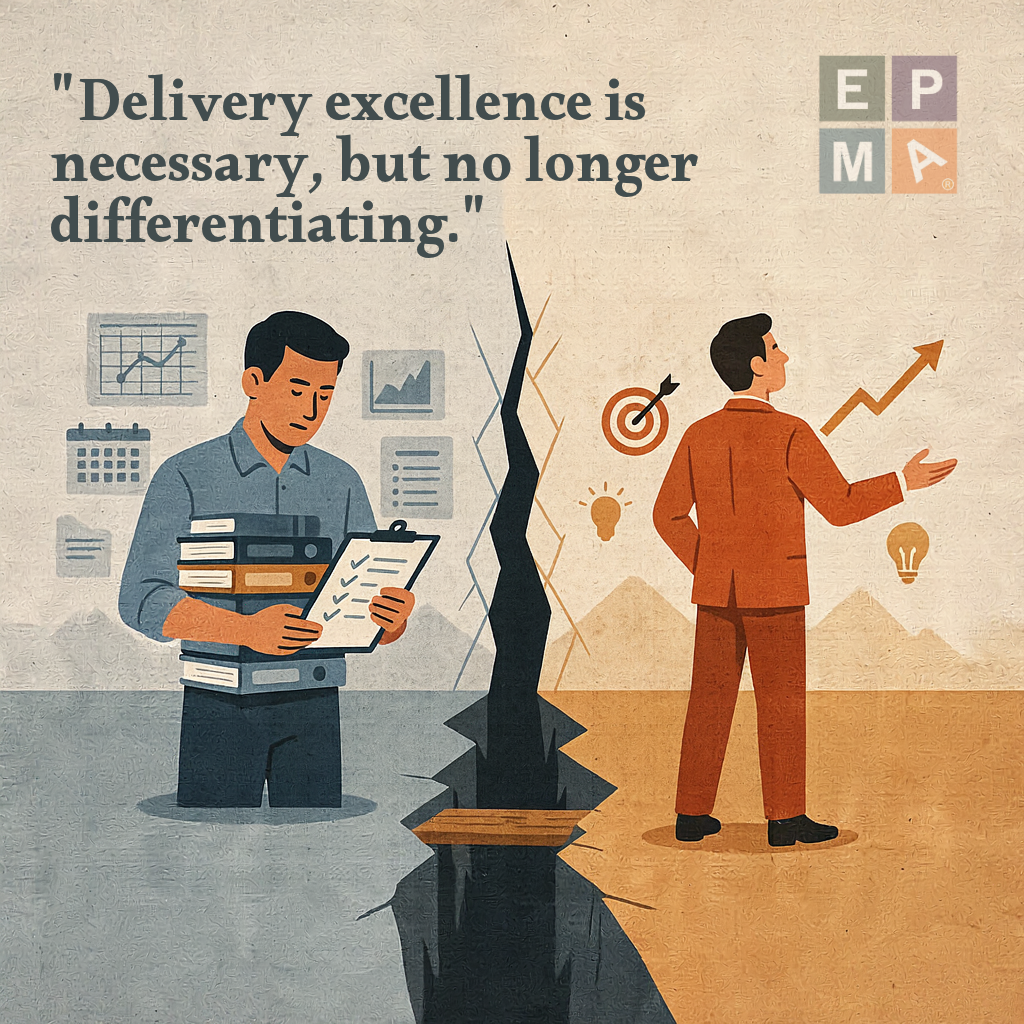
“Delivery excellence is necessary, but no longer differentiating. Executives expect reliable execution. What they reward is strategic contribution.”
Read that twice. Every word matters. Delivery is now assumed. It’s the price of entry, not the differentiator. If your PMO’s value story is built on “we deliver projects on time and on budget,” you’re answering a question executives stopped asking. They’re paying you to do that. It’s not what they’re noticing you for.
There’s a companion line from the same research worth internalizing: “Executives feel that most strategies don’t fail in the boardroom, they fail in execution.” That’s what senior leaders actually lose sleep over. Not whether individual projects hit dates, but whether the collective execution engine is producing the strategic outcomes the business committed to. That is a fundamentally different job than what most PMOs are currently staffed to do.
What executives are actually rewarding now
The PMI research points to four areas where executives now want their PMOs investing more, and where most PMOs are underinvested.
- Strategic alignment work. Not just executing the strategy handed to the PMO. Actively participating in shaping what the strategy execution portfolio looks like. Bringing execution reality into strategy conversations early enough to change the strategy, not just implement it. Most PMOs are still on the receiving end of strategy. Executives want them at the table when it’s being formed.
- Benefits realization. Not whether projects finished on time. Whether they produced the business outcomes they were supposed to produce. This requires the PMO to stay engaged with projects after they close, measure actual value delivered against original business cases, and honestly report when projects delivered less than promised. Most PMOs stop measuring at project closure, which is exactly when the benefits question starts.
- Customer relationship management. Executives are increasingly measured on customer outcomes. They want PMOs that understand how project execution affects customer experience, and can prioritize the portfolio through that lens. This is one of the largest gaps in the PMI data: executives outweigh PMO leaders by 25 points on how important this is.
- Business acumen at the PM level. Not project management certifications. Actual understanding of the P&L, the market, the competitive dynamics, and the business model. PMI’s 2025 Pulse of the Profession found that only 18% of project professionals rate as having high business acumen, even though the ones who do show 27% lower project failure rates. Executives want PMs who can hold a real conversation about the business impact of a portfolio decision, not just its schedule.
Why PMOs got stuck investing in the wrong half
The mismatch isn’t because PMO leaders are ignoring what executives want. It’s because the entire infrastructure around PMOs was built to reward the old definition of value. Fixing it requires more than a mindset shift.
Consider the professional development math. PMI’s data shows 46% of PM professional development hours still go to technical training (project management methodologies, tools, certifications) versus just 25% to business acumen. That ratio was set when technical mastery was the differentiator. It hasn’t updated even though the definition of value has moved. Every year that ratio stays the same, PMs are becoming more technically proficient at exactly the skills that no longer differentiate them.
The measurement systems have the same problem. Most portfolio dashboards, PMO scorecards, and quarterly reports were designed to demonstrate delivery excellence. They report on-time percentages, budget variance, and resource utilization. These metrics make PMOs look productive to other PMOs. They don’t answer the questions executives are actually asking about strategic contribution and business outcomes.
And there’s a sponsorship problem. PMO leaders who have tried to shift their function toward strategic contribution often run into executives who say they want that shift but don’t fund it, don’t staff it, and keep measuring the PMO on the old metrics anyway. Both sides have to move at once, and neither side usually knows how to start the conversation with the other.
Feeling this gap in your own operation?
EPMA works with PMO leaders and their executive sponsors to redesign the PMO’s operating model around what actually creates value for the business today. If your PMO is delivering well and your executive team isn’t seeing it, or if you’re an executive trying to articulate what you want your PMO to become, that’s the conversation we’re built to have.
What the shift actually looks like
Closing the gap requires concrete changes on both sides. For PMO leaders, some of the highest-leverage moves:
- Rebalance your PM development investment. Move from 46% technical / 25% business acumen toward something closer to 40% each, with the rest on soft skills and specialized capabilities. This is not an argument against technical rigor. It’s an argument for a workforce that can operate in both languages.
- Redesign your executive reporting cadence. The monthly “on-time / on-budget / on-scope” scorecard is not what executives want anymore. Try replacing one monthly report with a quarterly benefits realization review that asks: “which of the projects we closed last quarter actually produced the outcomes we committed to?” That question changes what everyone downstream focuses on.
- Ask to be in strategy conversations, not just execution ones. The PMO leader who shows up to quarterly strategy planning with a portfolio execution perspective adds more value than the one who receives the strategy afterward. Being in the room early changes the strategy itself and it changes how executives perceive the PMO’s role.
- Reframe how the PMO talks about itself. “We deliver projects” is not the pitch anymore. “We help the business execute its strategy” is. Same underlying work, fundamentally different positioning. The language your PMO uses about itself trains executives on how to value it.
For executives who want a PMO that produces strategic contribution:
- Fund the shift you’re asking for. If you want your PMO leader operating at the strategic contribution level, they need budget for business acumen development, permission to participate in strategy conversations, and measurement systems that reward the new work. Asking for the shift without funding it produces frustration on both sides.
- Change what you ask about at the quarterly business review. Stop asking your PMO for delivery percentages. Start asking about benefits realization, customer impact, and strategic alignment. The questions you ask are the strongest signal to your PMO about what actually matters to you.
- Give the PMO leader real strategic sponsorship. Not a dotted line to an SVP who nods politely. Real involvement in strategy formation, real accountability for strategic outcomes, and real air cover when the PMO needs to push back on unrealistic executive commitments.
The PMOs that will matter in 2027
The PMOs that come out of the next 18 months looking essential to their organizations won’t be the ones with the tightest governance or the cleanest portfolio dashboards. They’ll be the ones whose leaders shifted their investment mix toward what executives actually reward: strategic contribution, benefits realization, customer outcomes, and business acumen.
The gap is real. It’s also solvable. What it requires is honesty from both sides. PMO leaders need to acknowledge that their traditional value story isn’t landing anymore, and executives need to acknowledge that they haven’t been consistently funding or measuring the PMO around what they claim to want. When those two conversations happen at the same time, the shift starts. When they don’t, the gap widens.
Kaly Samadi is President & CCO of EPMA, a project management consulting, staffing, and technology firm. EPMA helps PMO leaders and delivery executives design operating models, measurement systems, and workforce plans that produce the strategic contribution their organizations actually reward.
Sources
Project Management Institute, Bridging the Gap: Positioning PMOs as Indispensable Partners in Strategy Execution (January 2026)
Project Management Institute, Pulse of the Profession 2025 (business acumen and failure rate correlation data)