
Most organizations have an official project management system. They just don’t actually manage projects in it. That’s not a criticism, it’s a pattern seventeen years and dozens of organizations have made impossible to ignore.
The Pattern Nobody Talks About Out Loud
A system gets implemented; Project Online, or a financial platform with a project management module built in, and people just use it for exactly what they have to. They enter what finance needs to see. They populate what feeds the executive report. They do the minimum the system requires of them.
And then they do the actual work of managing projects somewhere else.
This is not laziness or poor discipline. This is what happens when a system doesn’t quite fit how people actually work, and people are too busy delivering projects to fight the system. So they route around it. Slowly, practically, and over time – permanently.
This gap between the official system of record and the real system of work is one of the most consequential and least-discussed problems in enterprise project management. It shapes what leadership sees, how decisions get made, and whether the organization can actually learn from its project portfolio or just report on it.
Where the Work Actually Goes
Ask a project manager where their project really lives and the answer is almost never “in the system.” The real work of running a project gets distributed across a half-dozen informal tools – each one chosen because it was more useful than the official system for that specific purpose.
The Spreadsheet
Built by the PM themselves because the system’s scheduling view didn’t work the way they think. Updated weekly, local to one person, invisible to the portfolio.
The Email Chain
Between the PM and the key stakeholder where actual project direction gets negotiated. Informal, unstructured, and entirely outside the system of record.
The PowerPoint
Assembled by hand every week, pulling from the official system, the spreadsheets, the emails, and someone’s memory, then reformatted for thirty minutes on a Tuesday morning.
The SharePoint Library
Full of status reports and action item logs updated manually every week. A graveyard of good intentions disconnected from any live data source.
The Teams Channel
Where the real status conversations happen. Decisions get made in threads that nobody outside the team ever sees and no audit trail is attached to the official record.
The Financial System Trap
A specific and particularly stubborn version of this problem shows up in organizations that rely on a financial system with a project management module. These platforms were built for accounting and financial reporting. The project module exists to satisfy budget tracking and cost allocation, not to help a project manager actually run a project.
So project managers use it for what it’s actually designed for: recording costs, logging actuals, satisfying the finance team’s reporting requirements. Everything else – scheduling, risk tracking, resource planning, stakeholder communication, real project status – happens outside the system, in whatever tools people find most convenient.
The result is a dangerous asymmetry that most organizations have unintentionally normalized.
The Visibility Gap
Finance has visibility into project costs.
Nobody has visibility into project health.
And those are very different things. One tells you what you’ve spent. The other tells you whether you’ll get what you paid for.
What This Actually Costs the Organization
When the real project data lives in email threads, spreadsheets, and Teams channels instead of a shared system, a few things become structurally impossible, regardless of how talented or committed your people are.
Leadership Can't See the Real Picture
The executive report shows what’s in the official system, which is a subset of reality, filtered through what got entered and what someone remembered to update. Decisions about priorities, capacity, and investment get made on incomplete information, and everyone in the room knows it even if nobody says it.
Problems Surface Late
When status lives in email and Teams channels, risks and issues don’t get escalated, they get buried in conversation threads. By the time something becomes visible at the portfolio level, it’s already a crisis instead of an early warning. The system never had a chance to flag it.
Reporting Is a Manual Tax on Your Best People
The hours spent every week pulling data from six places and assembling it into a coherent picture are hours not spent on delivery. In most organizations, this is someone’s part-time job that nobody formally acknowledges, and nobody has ever calculated the true cost of.
Institutional Knowledge Walks Out the Door
The spreadsheet logic, the context in the email threads, the understanding of what the Teams channel shorthand actually means. None of that is in a system. It’s in people’s heads. When they leave, it goes with them.
Why the System Doesn't Get Fixed
The obvious question is: if everyone knows this is happening, why doesn’t the organization fix it? The answer is usually some combination of three things.
The official system is too heavy to change, too expensive to replace, or too embedded in other processes to touch. The organization has built reporting workflows, integrations, and compliance processes around it, and untangling any of that feels like more risk than it’s worth.
Or because the organization already tried to fix it. They ran a big implementation, trained everyone, mandated adoption and watched people quietly go back to their spreadsheets within three months. That experience left scar tissue. Nobody wants to run the same play and get the same result.
The failure mode of most PPM implementations isn’t the technology. It’s that the system was built around what the organization wanted to capture, not around how project managers actually work.
When the tool is more burden than benefit from a PM’s perspective, they find workarounds. Every time. A system that reduces administrative burden that makes it easier to manage a project than to work around it will get used. A system that adds friction gets abandoned. That’s not a technology problem. It’s a design problem.
A Design Problem, Not a Technology Problem
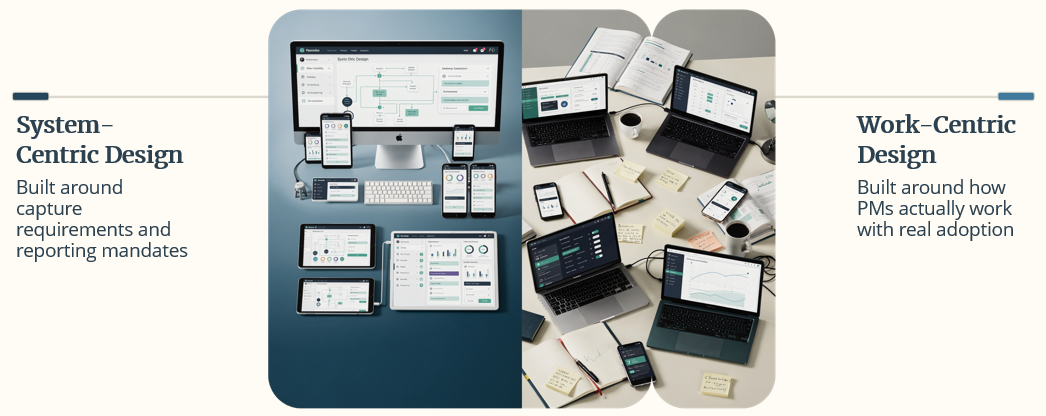
The distinction matters because it reframes what a successful PPM implementation actually requires. Buying better technology is easy. Designing a system around how work actually happens, rather than how leadership wishes it would happen, is the harder and more important problem. The organizations that solve it get both adoption and insight. The ones that don’t get compliance theater.
The Right Question to Ask Right Now
For organizations navigating the Project Online retirement, this is the moment to be honest about that question before choosing a replacement. The temptation is to ask: What is the closest equivalent to what we had? That question will lead to a lift-and-shift that generates exactly the same workarounds in a new environment.
The better question, the one that actually leads somewhere different, is this:
Why were our project managers working around the system in the first place? And what would a system have to look like for them to actually use it?
The organizations that come out of this transition in a genuinely better position are the ones that use it as a forcing function for honesty. Not just about the technology, but about what project management in their organization actually needs to look like and whether the tool they’re choosing is designed around that reality or around someone else’s idea of best practice.
A real look at that question, answered honestly, is worth more than any feature comparison matrix.
Three Questions Worth Asking Before You Choose a Replacement
Before you evaluate platforms, run vendor demos, or stand up a selection committee, ask these three questions internally. The answers will tell you more about your actual problem than any RFP response.
1. Where do your PMs actually track status?
Ask your project managers where they actually track project status day-to-day. If the answer involves spreadsheets, email, or Teams and not the official system, that tells you everything about whether the current system is working. Don’t rationalize the answer. Take it at face value.
2. How long does the portfolio report take to build?
Ask whoever assembles the portfolio report how long it takes and what sources they pull from. If the answer is more than a few hours and more than one or two sources, you have a real-time visibility problem that a new system needs to solve rather than just replicate more elegantly.
3. How confident is leadership in what they're seeing?
Ask leadership honestly: how confident are you that the portfolio report reflects what’s actually happening? If the answer is “pretty confident” or “mostly,” then that gap is costing you more than you realize. And it won’t close just because you switched platforms.
The gap is in the question you haven’t asked yet.
The Conversation Worth Having
If you’d like to talk through what a system designed around how your team actually works could look like with an honest conversation about the gap between your official system and your real one, EPMA is happy to have that conversation.