
When delivery breaks down, the instinct is almost always the same: we need better software. In seventeen years of working inside project-driven organizations, EPMA has learned that the tool is rarely the root cause, and buying a new one without addressing what’s actually broken rarely fixes it. The organizations that come out stronger are the ones that ask harder questions first.
The Instinct Is Understandable - But Usually Wrong
The Common Reaction
Leadership can’t get a clear read on status. Resources are overcommitted and nobody caught it in time. The weekly report takes three hours to assemble. The answer feels obvious: we need better software.
The Harder Truth
The tool is rarely the root cause. The organizations that improve delivery outcomes are the ones willing to ask harder questions before opening a procurement process. Sometimes a new platform is the right answer. But it’s almost never the first answer.
EPMA has had this conversation across hundreds of mid-market firms. The pattern is consistent. And it starts with understanding where project status actually lives.
The Real Problem Rarely Lives in the Software
Walk into almost any mid-market firm and ask where project status actually lives. The answer is almost never “in the system.” It’s in the spreadsheet a PM built because the official tool didn’t work the way they think. It’s in the Teams channel where real decisions happen. It’s in the email chain where scope is shifting, undocumented and untracked.
The Spreadsheet
A PM built it because the official tool didn’t support how they actually work. It’s more accurate than the system of record and everyone knows it.
The Teams Channel
Real decisions happen here, not in the platform. Scope gets renegotiated. Risks get flagged. Status gets shared. None of it is captured where leadership can see it.
The Friday PowerPoint
Someone assembles it by hand every week from six different sources. Half a day of effort. Nobody fully trusts it, but everyone acts like they do.
This isn’t a technology failure. It’s a design failure. The system was built around what leadership wants to capture, not around how project managers actually work. So PMs route around it unintentionally, practically, and over time permanently. Buying a new tool doesn’t fix that. It just gives people a new system to route around.
Three Foundational Questions That Must Come Before Any Technology Decision
One of the most common mistakes in project delivery improvement is treating a technology problem what is actually a process and people problem. Before any platform evaluation, three foundational questions need honest answers.
(1) Are your processes defined well enough to be supported by a tool?
If your project delivery process varies by business unit, by PM, or by project type; if there’s no consistent standard for how projects get initiated, tracked, or closed; a new tool will simply automate the inconsistency. You’ll have a more expensive version of the same fragmented picture.
2) Are your roles and responsibilities aligned with what people can actually deliver?
Engineers or technical leads taking on PM responsibilities is one of the most common patterns in project-driven firms. These are different skillsets. When the same person is accountable for both technical delivery and project governance, something gives – usually the governance. No PM tool fixes a capacity or role clarity problem.
(3) Do your people have the skills and bandwidth to adopt something new?
Tool adoption fails most often not because the tool is bad, but because the people expected to use it are already at capacity. Adding a new system on top of an already overburdened team without changing what they’re asked to do almost always ends in abandonment.
Heroes Don't Scale. Systems Do.
The current model in most project-driven organizations relies on heroic individual effort rather than systematic enablement. Heroes don’t scale. Systems do.
The fundamental issue isn’t a lack of talent or commitment. Most project-driven firms are staffed with capable, hardworking people who care about delivery. The problem is structural. When delivery depends on individual heroics, the one PM who knows where everything stands, the one analyst who can pull the reporting together, that capability is fragile, non-transferable, and doesn’t survive growth or turnover.
A new platform doesn’t create accountability where it didn’t exist before. It won’t standardize execution across teams that each have their own way of doing things. It won’t resolve unclear roles or competing priorities. Systems enable people. But only when the people, process, and accountability structures are already in place to use them.
Two Patterns We See Every Time We Walk In
EPMA has had this conversation with a lot of organizations recently. Two patterns come up constantly, and both point to the same underlying gap.
Pattern 1: The Financial System Trap
There’s an official system, usually a financial platform with a PM module bolted on. People use it for what finance requires: cost codes, budget tracking, actuals. Everything else happens in spreadsheets and email. Leadership gets a PowerPoint report every week that someone spent half a day assembling from six different sources. Nobody fully trusts it, but everyone acts like they do.
Pattern 2: The Failed Implementation
An organization invested in a real PM platform. Trained everyone. Mandated adoption. Within three months, people went back to their spreadsheets, because the tool added more overhead than it removed and the underlying processes were never actually defined. Now there’s a license nobody’s using and leadership still flying blind. There’s also scar tissue. Nobody wants to run the same play and get the same result.
In both cases, the problem isn’t the software. It’s the gap between how delivery actually happens and what the system was designed to support.
Foundation Before Technology: An 800-Person Engineering Firm: Case Study
A civil and environmental engineering firm with over 800 employees engaged EPMA to assess their project delivery operations. They were growing aggressively, including through acquisition, and their existing approach to project management was becoming a structural constraint on that growth.
What We Found
Financial System Doing Double Duty
Their financial platform served effectively as the system of record for billing, AR, and time management, but critical delivery mechanisms were not consistently captured anywhere shared.
Delivery Data Scattered Everywhere
Work breakdown structures, project schedules, risk logs, change orders, and decision documentation lived in PM-owned spreadsheets, shared network drives, SharePoint sites, and email archives.
Role Clarity Problem
Many project managers were also serving as technical leads, wearing both hats simultaneously. Accountability for delivery was diffuse with no consistent mechanism to enforce delivery discipline.
What Leadership Couldn’t Answer
The data fragmentation wasn’t an inconvenience. It was a strategic liability. With delivery information scattered across personal files, local drives, and informal channels, the leadership team faced a set of questions they simply could not answer reliably.
Portfolio Forecasting
Leadership couldn’t reliably forecast across the portfolio or see forward-looking resource demand against committed work.
Variance Detection
Variances couldn’t be detected until they became financial problems, by which point the window for proactive intervention had closed.
Capacity Visibility
The fundamental question, does the organization have the capacity to deliver everything it has committed to, had no reliable answer.
What EPMA heard consistently from their teams: the administrative overhead of keeping multiple systems current was so high that people abandoned the systems and defaulted to informal coordination. The tools weren’t wrong. The foundation wasn’t there to support them.
What We Recommended – And Why
The recommendation was not to implement a new PPM platform. Not yet. The recommendation was to establish the foundation first, three interconnected pillars that had to come before any technology investment would stick.
Pillar 1: System of Record Clarity
Keep the financial system doing what it was designed for. Introduce a dedicated project execution hub, built on their existing Microsoft 365 environment, for work plans, risks, change orders, and delivery tracking. Two systems with clear, separate purposes, connected through Power BI for unified reporting.
Pillar 2: Minimum Viable Execution Standards
Define a small set of non-negotiables for every project regardless of size: milestone tracking, a RAID log, formal change capture, and client sign-off at closeout. Lightweight by design. Focused on control points, not comprehensive documentation. Discipline, not bureaucracy.
Pillar 3: Leadership-Enforced Accountability
Define who owns what, clearly and with consequences. PMs own scope and delivery. Resource managers own staffing and utilization. Business unit heads own portfolio performance. Without accountability structures backed by leadership, standards become suggestions.
The Delivery Enablement Pod
To execute this without overwhelming the organization, EPMA proposed a small embedded team, a Delivery Enablement Pod, rather than a large consulting engagement. The model was designed to keep direction firmly with their leadership while adding targeted execution capacity.
Senior PM Embedded with Leadership
Focused on defining execution standards, organizing processes in SharePoint, and identifying automation opportunities, working directly alongside the leadership team, not alongside the vendor.
Technical Advisor on a Parallel Track
Translating documented processes into automation requirements so that when the organization was ready to build, the scope was already defined. No wasted discovery cycles. No scope creep from undefined requirements.
The design principle: not a program, but a working group. One that could show progress in 60 days, not 6 months. Automation should follow process clarity, not precede it. When you automate a broken process, you get a faster broken process.
The Two Paths Forward
When EPMA comes into an engagement, the first conversation is never about which tool to buy. It’s about what’s actually broken and what would genuinely fix it. That conversation usually leads to one of two paths, or a sequence of both.
Path 1: Build Structure Around What You Already Have
For organizations where the problem is process discipline and role clarity rather than platform capability, the right answer is often to build structure in place. Define the execution standard. Build the accountability framework. Create reporting visibility on the tools people already use. Automate the highest-friction workflows. Do this before introducing anything new, so that when you do, the foundation is there to support it.
Path 2: Implement a Platform Designed Around How Your Team Works
For organizations where the existing environment genuinely can’t support what they need, or where the foundation has been built and they’re ready for the next level, a purpose-built PPM platform is the right answer. But the platform has to be chosen based on how the team actually works, not on what the vendor’s demo looks like.
Seven Questions to Ask Before You Decide
Before you evaluate platforms, request demos, or stand up a selection committee, spend an hour answering these questions honestly. The answers will tell you more about what you actually need than any vendor RFP response.
- Why are your PMs working around the current system?
Ask your project managers directly, not in a survey, in a real conversation, where they actually track project status day-to-day. If the honest answer is spreadsheets, email, or Teams channels, that’s your diagnostic. The next question is whether that gap is a process problem or a platform problem.
- Are your processes defined well enough to be supported by a system?
If your project delivery process varies by team, by PM, or by project type, a new tool will automate the inconsistency, not fix it. Before technology, you need process clarity.
- Are your roles and responsibilities clear and realistic?
Who owns scope? Who owns resource allocation? Who owns portfolio performance? If the answer is “it depends” or “everyone and no one,” that’s an accountability gap that technology won’t close.
- What does your leadership team not know that they should?
Get specific. Not “visibility is limited,” but exactly what questions can’t leadership answer today? Resource load? Budget burn against forecast? Which projects are actually at risk vs. reporting green?
- What happened the last time you tried to fix this?
Most organizations have tried at least once. A big implementation that didn’t stick. A new tool that got abandoned. A process initiative that nobody formally cancelled but everyone stopped following. Understanding why the last attempt failed is the most important input into making sure the next one doesn’t. If the answer is “people didn’t adopt it,” ask why, and whether that reason has actually changed.
- How will you handle the change management side?
Technology implementation succeeds or fails based on user adoption. Organizations that treat PM improvement as a technology project fail at a much higher rate than those that treat it as a people and process change that technology enables. Before you pick a platform, know how you’re going to bring your PMs along, what’s in it for them, how you’ll reduce their administrative burden rather than add to it.
- Are you ready for a new platform, or do you need to build the foundation first?
This is the hardest question to answer honestly, because the answer might be: not yet. If your processes aren’t defined, your roles aren’t clear, and your last implementation failed because of adoption, the right move might be to build the foundation on your existing tools first. Get the discipline in place. Prove that it sticks. Then layer in a more sophisticated platform when the organization is ready to use it.
The organizations that implement sophisticated platforms on top of a solid foundation get adoption and insight. The ones that implement platforms to create the foundation they’re missing get expensive tools that people work around.
Diagnosing the Real Problem: A Framework
Most project delivery assessments jump too quickly to solution mode. The right diagnostic follows a clear sequence from symptoms to root causes to the right intervention. Use this framework before any vendor conversations begin.
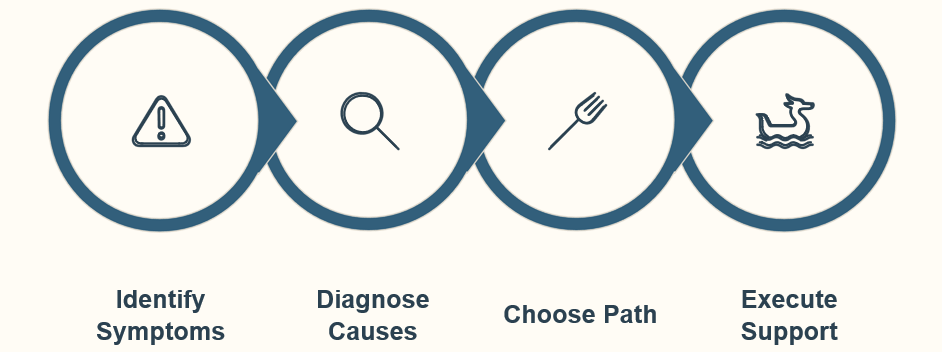
The sequence matters as much as the steps. Organizations that skip from symptoms directly to solution selection – jumping from “our reporting is broken” to “let’s buy a new platform,” almost always end up back where they started. The diagnostic layer is what determines whether you’re solving the right problem.
What "Foundation First" in Practice
Building the foundation before investing in technology isn’t about slowing down. It’s about ensuring that when you do move, you move once. Organizations that have done this well share a consistent pattern of activities that happen before any platform procurement begins.
Document How Work Actually Happens
Not how the process was designed, how it actually runs. Where do PMs spend their time? What do they track and where? What decisions get made without documentation? This baseline is the foundation for everything that follows.
Clarify Roles with Real Accountability
Map who owns what across the delivery lifecycle, scope, scheduling, resource allocation, risk, portfolio performance. Define it with enough specificity that “it depends” is no longer an acceptable answer. Accountability gaps don’t close themselves.
Define the Minimum Viable Standard
Identify the smallest set of non-negotiables that would give leadership the visibility they need. Not a comprehensive methodology, a handful of control points that apply to every project, regardless of size or type. Discipline, not bureaucracy.
The Change Management Imperative
Technology implementation succeeds or fails based on user adoption. Yet adoption is consistently the last thing organizations plan for, and the first thing that breaks down. Before any platform decision, the change management strategy needs to be as concrete as the implementation plan.
Why Adoption Fails
The most common reason PM tools get abandoned isn’t that the tools are bad. It’s that the people expected to use them are already at capacity. Adding a new system on top of an already overburdened team, without changing what they’re asked to do in that system, almost always ends in abandonment. The tool sits unused while the spreadsheets keep running.
The second most common reason: PMs don’t see the value. The system was designed for leadership visibility, not PM workflow. It creates more work without removing any. Until the tool makes a PM’s day easier, not just leadership’s reporting easier, adoption will be a constant battle.
What Successful Adoption Looks Like
- Leadership visibly uses and reinforces the new way of working
- PMs see reduced administrative burden, not increased overhead
- The tool supports how teams actually work, not an idealized process
- Training is role-specific, not generic platform walkthroughs
- There’s a clear answer to “what’s in it for me?” for every user
- Quick wins are visible within 60 days, sustaining momentum
When a Purpose-Built Platform IS the Right Answer
Building foundation first isn’t a permanent alternative to a dedicated PPM platform. It’s the prerequisite. For organizations where the foundation is in place, or where the existing environment genuinely cannot support what delivery demands, a purpose-built platform is the right next step.
Not the Enterprise Overkill
Enterprise PM platforms are built for organizations with dedicated PMO teams, compliance requirements, and the administrative bandwidth to run them. Mid-market firms rarely have that. An enterprise platform in a mid-market firm almost always means a significant portion of the capability goes unused, while the overhead of maintaining it doesn’t.
Not the Lightweight Task Manager
Task managers and project apps work well at the project level. They miss the portfolio layer entirely, resource utilization across projects, capacity planning, financial performance against forecast, cross-project risk visibility. For project-driven firms where delivery outcomes drive business outcomes, the portfolio layer isn’t optional.
Built for How PM Actually Happens
EPMA built PPMX specifically for this moment, a platform designed by practitioners for how project management actually happens in mid-market firms. The right platform is chosen based on how the team actually works, not on what the vendor’s demo looks like.
The Sequence that Works
For most mid-market project-driven organizations, the path to sustainable delivery improvement follows a sequence. The specific timeline varies, but the order rarely does
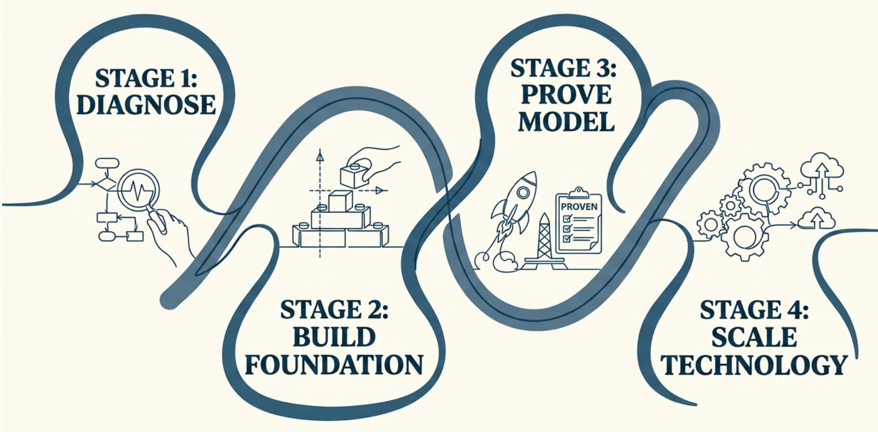
The insight that makes this sequence work: every stage creates the conditions for the next one to succeed. Foundation-building without a diagnostic misses the root cause. Platform implementation without a proven foundation repeats the cycle. The organizations that execute this sequence, even imperfectly, consistently outperform those that shortcut to technology.
What Organizations on the Other Side Look Like
The goal of this work is not better software. It is a delivery organization where leadership can get a reliable read on portfolio health without sending emails or making calls, where problems surface early enough to act on them, and where the fundamental question, do we have the capacity to deliver everything we have committed to, has an actual answer.
That looks different for every organization, but the patterns are consistent.
Reporting stops being a weekly fire drill. The Friday PowerPoint that someone spent half a day assembling from six different sources gets replaced by a dashboard that reflects reality, because the data feeding it is being captured consistently at the source.
Problems get caught earlier. When execution signals, milestones, risks, change orders, are captured in a shared system, variances surface weeks before they become financial problems. Leadership stops discovering issues during client escalations or budget reviews.
PMs spend less time on administration. When the system is designed around how they actually work, not around what leadership wants to see, the overhead drops. Updates take minutes, not hours. The tool earns its place in the workflow.
The organization can scale. New PMs ramp faster because there are standards to follow. Acquisitions integrate more smoothly because there is a defined way of working to adopt. Knowledge stops walking out the door when people leave.
The organizations that get here are not the ones that bought the most sophisticated platform. They are the ones that built the foundation first, proved it could hold, and then layered in technology at the right time.
The Conversation Worth Having First
If any of these patterns sound familiar, the financial system doing double duty, the failed implementation with the scar tissue, the Friday PowerPoint nobody fully trusts, the right next step isn’t a demo. It’s a diagnostic conversation.
EPMA has recent examples from firms in your space worth sharing. Organizations that have worked through this, found the right sequence, and come out on the other side with delivery discipline that actually holds. If you’d like to see how we’ve approached this, just say the word and we’ll send them over.