
In today’s fast-paced business environment, effective resource management is critical to project success, yet many organizations continue to struggle despite investing in sophisticated systems and processes. Let’s examine why resource management challenges persist and reveal that the core issue isn’t inadequate systems but rather insufficient visibility across the organization. We’ll explore how limited visibility creates cascading problems, identify what conventional tools miss, and provide practical strategies to transform resource management from a source of friction to a competitive advantage, all without requiring massive system overhauls or disruptive process changes.
Understanding the True Nature of Resource Management Problems
When projects fall behind, teams become overextended, or equipment sits idle, the typical organizational response follows a predictable pattern: purchase a new system, upgrade existing tools, or implement stricter processes to enforce accountability. This approach assumes that the problem stems from inadequate infrastructure or lack of discipline.
However, this reactive approach often fails to address the underlying issue. Resource management challenges typically aren’t system problems, they’re visibility problems. The distinction is crucial because it fundamentally changes how organizations should approach solutions.
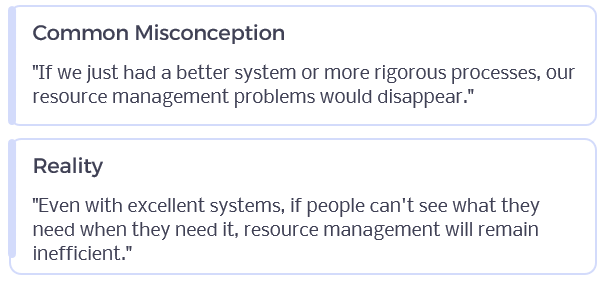
A system problem suggests that with the right tool or process, resources would be efficiently allocated and tracked. A visibility problem, on the other hand, recognizes that the issue isn’t about tracking or allocation mechanisms, but rather about ensuring that the right information reaches the right people at the right time to enable informed decisions.
Organizations often have the data they need somewhere in their ecosystem, but it remains trapped in silos, obscured by complexity, or accessible only to specific roles. This visibility gap means that while the information exists, it isn’t serving its purpose of enabling better decisions.
When visibility is lacking, resource management becomes reactive rather than proactive. Teams respond to conflicts after they emerge rather than preventing them. Decisions are based on partial information or outdated data. And the organization loses agility because reallocating resources requires untangling complex dependencies that aren’t immediately apparent.
Recognizing that visibility, not systems, is the core challenge opens up more practical, immediate solutions than embarking on yet another system implementation or process redesign.
The Hidden Costs of Poor Resource Visibility
Operational Inefficiency
When teams lack visibility into resource availability, double-booking becomes common. This creates last-minute scrambles, emergency reallocation, and disruption to multiple projects simultaneously. Similarly, equipment and other physical resources may sit idle in one location while being desperately needed elsewhere, simply because no one has visibility into the complete picture.
Decision Quality Deterioration
Without clear visibility, project managers are forced to operate on instinct rather than insight. They make commitments based on hope rather than data, leading to unrealistic timelines and eventual disappointment. Meanwhile, organizational leaders make strategic decisions using outdated or incomplete information about resource capacity, leading to misaligned priorities and initiative overload.
Hidden Opportunity Costs
Perhaps most significantly, poor visibility obscures opportunity costs. Organizations cannot easily see which high-value initiatives are being delayed by resource constraints, or which skills are consistently in short supply. This prevents strategic reallocation of resources to maximize value and hinders long-term capability planning.
The most insidious aspect of poor visibility is how it normalizes inefficiency. Organizations come to accept constant resource conflicts, heroic last-minute efforts, and the accompanying stress as simply “the way things work.” This normalization masks the true cost to both the organization and its people. Teams spend increasing amounts of time in coordination meetings, status updates, and email threads, creating work about work rather than delivering value.
Over time, this erosion of efficiency doesn’t just impact project timelines and costs, it damages team trust and engagement. When resource allocation feels arbitrary or conflicts arise repeatedly, team members lose confidence in leadership’s ability to create an environment where they can be successful.
Where Traditional Resource Management Tools Fall Short
Most organizations have invested in some form of resource management infrastructure, whether sophisticated project portfolio management (PPM) tools, custom-built spreadsheets, visual dispatch boards, or specialized time-tracking systems. Yet despite these investments, resource visibility problems persist. Understanding why these tools fail to deliver the needed visibility is crucial to finding effective solutions.
Siloed Systems
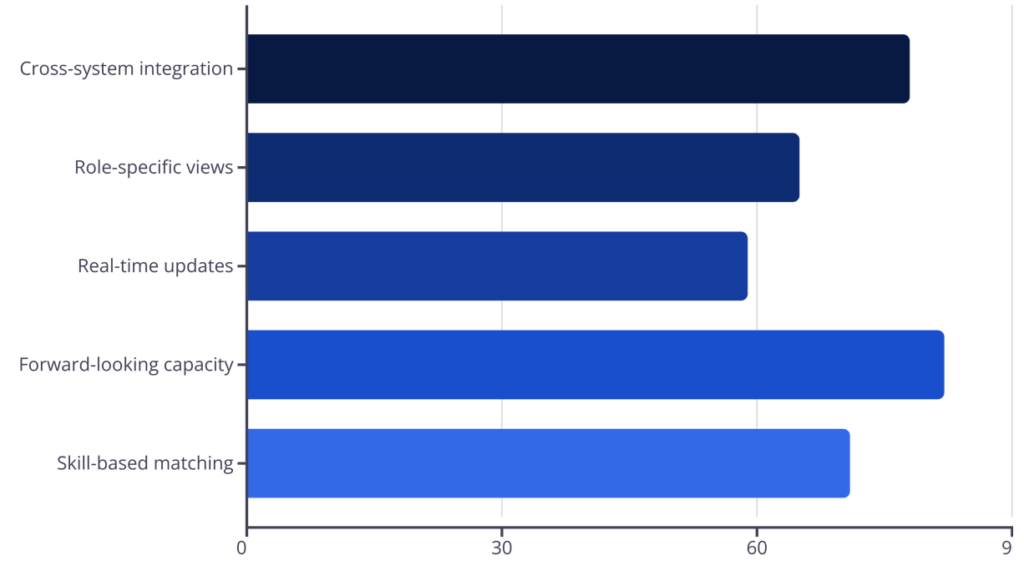
The most common failure point is that resource information lives in multiple disconnected systems. Project schedules exist in one tool, equipment allocations in another, and skill profiles in yet another. Without integration, no single view captures the complete resource picture.
One-Size-Fits-All Views
Even sophisticated tools often provide the same view to everyone, failing to recognize that different roles need different levels of resource visibility. Executives need portfolio-level capacity views, project managers need detailed allocation and conflict alerts, while team members need clear task priorities.
Backward-Looking Data
Many resource systems focus on tracking past allocations rather than providing forward-looking visibility. This historical focus helps with accounting but fails to support proactive decision-making about future resource needs.
Another critical shortcoming is that many tools require perfect data entry to function properly. When systems demand extensive manual updates or complex coding structures, teams inevitably take shortcuts or develop workarounds. This creates a vicious cycle where unreliable data leads to decreased system trust, which further reduces motivation to maintain accurate information.
Finally, traditional tools often excel at tracking tangible resources like equipment and hours but struggle with the nuances of skill-based allocation. They may show that a person is available without revealing whether they have the specific expertise needed for a particular task. This creates an illusion of capacity that doesn’t reflect reality.
Download the 1-page Infographic Summary PDF: Fixing the Invisible: The Real Resource Management Problem
Reimagining Resource Management: Flow vs. Structure
The key to solving resource visibility challenges lies not in creating more rigid structures but in enabling smarter information flow across the organization. This distinction represents a fundamental shift in how we approach resource management.
Traditional Approach: Adding Structure
- Implementing more comprehensive systems
- Creating stricter processes and controls
- Building more detailed reporting requirements
- Enforcing standardized resource codes and categories
- Centralizing resource allocation decisions
Flow-Based Approach: Enhancing Visibility
- Connecting existing systems through integration layers
- Creating role-specific visibility that shows what matters
- Enabling real-time awareness of changes and impacts
- Surfacing conflicts and dependencies proactively
- Distributing decision-making with appropriate guardrails
The flow-based approach recognizes that resource management information naturally exists in multiple places because different systems serve different primary purposes. Project management tools optimize for task tracking, HR systems for personnel management, and equipment systems for asset tracking. Trying to force all resource data into a single system often creates resistance and compromises the specialized functionality each system provides.

Instead of trying to centralize all resource data, the flow-based approach creates a connective layer that draws information from existing systems and presents it in ways that support specific decisions. This approach preserves the specialized functionality of each system while creating the cross-system visibility needed for effective resource management.
This connective approach also recognizes that different roles need different views of the same underlying resource data. Strategic leaders need aggregated capacity views to make portfolio decisions. Project managers need allocation details and conflict alerts to manage execution. And team members need clarity on priorities to focus their efforts effectivel
Practical Steps to Improve Resource Visibility
Enhancing resource visibility doesn’t require a complete system overhaul or months of implementation work. Organizations can begin improving visibility immediately by focusing on specific high-friction areas and implementing targeted solutions. The key is to start small, demonstrate value quickly, and expand based on validated results.

When designing visibility solutions, focus on the specific decisions that people need to make rather than trying to create comprehensive views of all resource data. For example, a project manager might need to quickly see which team members have the right skills and availability for an upcoming task, while an executive might need to understand aggregate capacity constraints across the portfolio.
Remember that visibility is not just about data, it’s about insight. Raw data about resource allocations becomes valuable only when it’s presented in a way that highlights conflicts, surfaces opportunities, or enables specific decisions. The goal is not to overwhelm people with more information but to provide the right information at the right time to support better resource decisions.
As you improve visibility in one area, use the momentum and credibility gained to expand to other high-friction areas. Over time, these incremental improvements can transform your resource management capability without requiring disruptive change.
Case Studies: Visibility Transformations in Action



Construction Firm Reduces Equipment Downtime
A mid-sized construction company struggled with equipment availability despite significant investment in an asset management system. By creating a simple daily visibility report that showed equipment location, utilization, and upcoming needs across all active projects, they reduced equipment idle time by 37% and eliminated most emergency rentals, saving over $450,000 annually.
Professional Services Firm Improves Utilization
A consulting organization was struggling with both over-utilization of key specialists and under-utilization of generalists. By implementing role-specific dashboards that gave practice leaders visibility into upcoming demand and available capacity, they improved overall utilization by 12% while reducing specialist overtime by 28%.
Manufacturing Firm Optimizes Specialist Utilization
A global manufacturing firm struggled with delays due to overcommitted engineering specialists across multiple product lines. By creating visibility into specialist assignments and project timelines, they reduced production delays by 18% and improved utilization by 25%—all without changing their core planning tools.
Organization
Visibility Challenge
Solution Approach
Results
Manufacturing
Production line specialists frequently double-booked across initiatives
Created an integrated calendar showing specialist allocations across maintenance, projects, and operations
42% reduction in schedule conflicts, 15% increase in on-time project delivery
Technology
Development resources stretched across too many concurrent projects
Implemented portfolio-level capacity visualization showing resource demand vs. availability
Project portfolio reduced from 26 to 18 active initiatives with 30% faster completion times
Financial Services
Subject matter experts unavailable when needed for regulatory projects
Created proactive conflict alerts that identified competing demands 4+ weeks in advance
62% reduction in regulatory deadline extensions, improved work-life balance for experts
The common thread across these success stories is their focus on targeted visibility improvements rather than wholesale system replacements. Each organization identified specific decision points where improved information flow would create the most value, then implemented focused solutions to address those needs.
Notably, many of these organizations maintained their existing systems but created new ways to extract, combine, and present the information those systems contained. This approach delivered faster results with less disruption than attempting to consolidate all resource data into a single new system.
Moving Forward: Creating Your Resource Visibility Strategy
Improving resource visibility is not a one-time project but an ongoing capability that organizations must continuously develop. As you move forward with enhancing resource visibility, consider these principles to guide your approach:
Start With Decisions, Not Data
Identify the critical resource decisions that drive the most value, then work backward to determine what visibility is needed to support those decisions effectively.

Connect, Don’t Consolidate
Focus on creating connections between existing systems rather than trying to force all resource data into a single tool. Preserve specialized functionality while improving cross-system visibility.
“You don’t fix resource management by implementing a new tool. You fix it by making the invisible visible—and giving your people the clarity to move with confidence.”
Make It Role-Specific
Recognize that different roles need different views of resource information. Tailor visibility to support specific decisions at each level of the organization.
Remember that technology is only part of the solution. Equally important are the processes that ensure information flows effectively and the capabilities that enable people to use that information for better decisions.
Recommended Next Steps:
- Conduct a visibility diagnostic using the assessment questions provided in this document to identify your highest-priority visibility gaps.
- Select one high-friction area where improved visibility would create immediate value, and map the end-to-end resource process to identify specific information needs.
- Implement a targeted visibility solution for your selected area, focusing on connecting existing information rather than creating new data collection requirements.
- Measure the impact of your visibility improvement on specific operational metrics and team experience.
- Use successful results to build momentum for addressing additional visibility gaps across the organization.
By approaching resource management as a visibility challenge rather than a system problem, you can unlock significant improvements without the cost, risk, and disruption of major system implementations. The key is to start small, focus on decisions that matter, and create connections that enable information to flow to the people who need it, when they need it.