
Most organizations think they have a people problem, a process problem, or a leadership problem. But what if the real issue runs deeper? When projects consistently stall, resources disappear, and your best performers burn out, it’s time to look at something more fundamental: your organizational design itself.
The way you structure accountability, allocate resources, and define cross-functional workflows isn’t just administrative housekeeping. It’s the invisible architecture that either enables execution or systematically undermines it. And most leaders don’t realize their org design is broken until it’s already costing them quarters of missed delivery, millions in wasted effort, and their top talent walking out the door.
This blog reveals five critical warning signs that your organizational structure is actively working against your delivery goals. If you recognize even two of these patterns, it’s time to act. Because while you’re busy fixing symptoms, your org design is quietly sabotaging every fix you implement.
Sign #1: No One Actually Owns Delivery
Walk into any status meeting and you’ll see it: everyone’s involved, everyone’s contributing, everyone has an opinion. But ask a simple question, “Who is accountable if this doesn’t deliver on time?“, and watch the room go quiet. Suddenly, people start looking at their notes. The uncomfortable truth emerges: work is happening, but no one is truly responsible for whether it succeeds.
This isn’t about blame. It’s about clarity. When accountability is diffused across multiple stakeholders, it effectively doesn’t exist. Scope creeps because there’s no single owner to say “this is out of bounds.” Deadlines slip because no one person is measured on hitting them. Trade-offs never get made because no one has the authority to make them.
The Warning Signs
- Status updates focus on activities, not outcomes
- Multiple people claim to be “leading” the same initiative
- Decisions require consensus from six different stakeholders
- No one can answer “what happens if this fails?”
You end up with what looks like delivery activity (meetings, updates, progress reports) without actual delivery accountability. Tasks get completed, but outcomes remain ambiguous. The project moves forward in theory while drifting in practice, and by the time anyone notices the gap between “done” and “delivered,” you’ve burned through budget and goodwill.
Sign #2: You Have to Fight for Resources
Begging for Headcount
Project managers spend weeks building business cases for resources that should be standard allocation
Escalating to Executives
Every resource request requires VP-level intervention because there’s no clear prioritization framework
Politicking for Support
Success depends more on relationship capital than project merit or strategic alignment
If your project managers are spending more time negotiating for resources than actually managing delivery, you don’t have a delivery system. You have a delivery war zone. In well-designed organizations, resource allocation follows strategic priorities through clear governance processes. Teams know what they’re getting, when they’re getting it, and what trade-offs were made to get there.
But in broken org designs, every resource is contested territory. Engineers get pulled in three directions because there’s no unified view of capacity. Budget sits frozen because no one has authority to release it. Vendors wait for approvals that require sign-offs from people who don’t understand the project. Your PMs aren’t managing work, they’re managing politics.
This isn’t just inefficient. It’s destructive. Your best people, the ones who could actually deliver, are exhausted from fighting internal battles before the real work even begins. Meanwhile, your weakest projects often get resources simply because someone was better at lobbying. Strategic priorities take a back seat to whoever screams loudest or has the most powerful sponsor. That’s not organizational design. That’s organizational chaos masquerading as flexibility.
Sign #3: Cross-Functional Projects Stall at Every Handoff
Watch a cross-functional project move through your organization and you’ll see the same pattern repeat: momentum builds within a team, then dies the moment it crosses a boundary. Marketing finishes their piece and tosses it to Product. Product does their work and hands it to Engineering. Engineering builds something and throws it back to Marketing for launch. At every handoff, the project loses context, loses urgency, and loses weeks.
This isn’t a communication problem that can be fixed with better meetings or Slack channels. It’s a structural problem. When teams are organized into functional silos with separate goals, separate metrics, and separate leadership chains, cross-functional collaboration becomes an exception that requires heroic effort rather than a normal way of working.
Within Teams:
Fast
Clear roles, aligned goals, direct communication. Work flows smoothly when it stays in one domain.
At Boundaries:
Slow
Handoffs require translation, re-prioritization, and renegotiation. Context gets lost. Ownership becomes unclear.
Across Functions: Stalled
No one owns the end-to-end flow. Each team optimizes for their piece while the customer outcome suffers.
The result? Projects that should take weeks take months. Simple changes require committee approvals. Innovation dies because no one wants to navigate the complexity of getting multiple departments aligned. Your org chart has created artificial walls where your delivery process needs seamless flow, and every project pays the price.
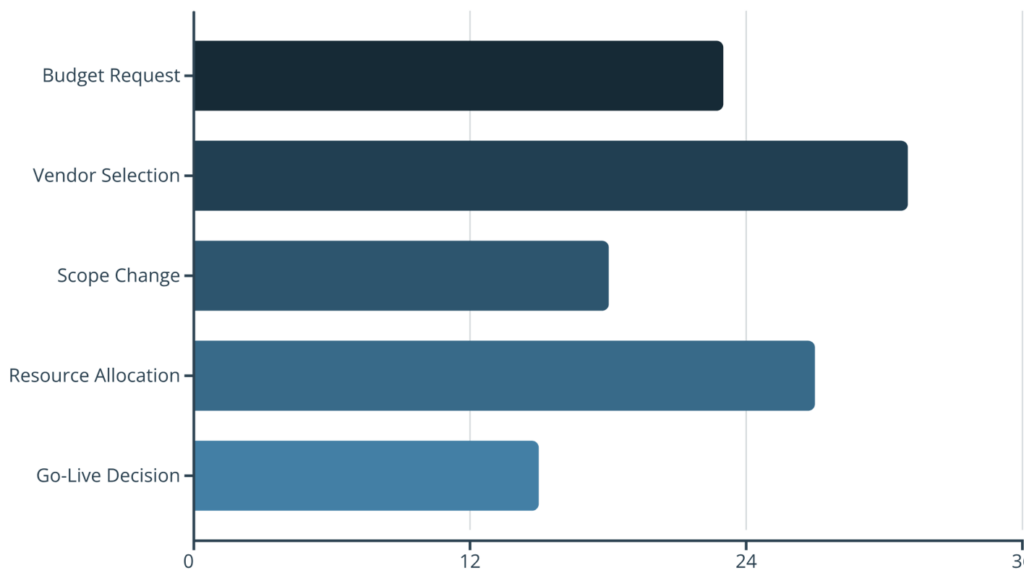
Sign #4: Your Approval Process is a Black Hole
There’s a special kind of organizational dysfunction that happens when approvals become opaque. Someone submits a request (for budget, for a decision, for permission to proceed) and it simply vanishes into the system. Days pass. Then weeks. Follow-ups yield vague responses: “it’s being reviewed,” “we’re waiting on feedback,” “it’s with leadership.” But no one can tell you who specifically is reviewing it, what criteria they’re using, or when you might get an answer.
This approval black hole is a symptom of organizational design where authority and accountability have become completely disconnected from the work. Decision rights are either so diffused that everyone needs to weigh in, or so concentrated that everything funnels through a handful of bottleneck executives who are already overloaded. Either way, the result is the same: execution grinds to a halt while everyone waits for someone, somewhere, to give a yes.
Sign #5: Your Best People Are Burning Out
Here’s the most painful sign that your org design is broken: your strongest performers are the ones suffering most. These aren’t people who can’t handle the work. They’ve proven they can deliver under pressure, navigate complexity, and drive results. They’re burning out not because the work is too hard, but because your organizational structure forces them to do work that shouldn’t exist.
Every day, your best people are compensating for broken design. They’re chasing down stakeholders who should be proactively engaged. They’re working around processes that create friction instead of flow. They’re personally absorbing every gap between departments because there’s no structural mechanism to bridge them. They’ve become human duct tape, holding together an organization that’s structurally unsound.
What They Should Be Doing
- Defining strategy and vision
- Solving complex problems
- Mentoring team members
- Driving innovation
- Delivering outcomes
What They're Actually Doing
- Chasing people for responses
- Navigating broken processes
- Translating between silos
- Escalating resource conflicts
- Filling structural gaps
This creates a vicious cycle. The more capable someone is, the more organizational dysfunction gets routed to them. They become the go-to person for everything that’s hard, which really means everything your org design doesn’t support. They can’t say no because they care about outcomes. They can’t delegate because the underlying structural problems remain. So they work harder, longer, and eventually they break.
When your top performers start leaving, exit interviews usually cite vague reasons: seeking new challenges, personal growth, better opportunities. But dig deeper and you’ll find the real story: they’re exhausted from fighting your organizational structure. They’ve realized that no amount of individual effort can overcome systemic design flaws. And they’ve decided to take their talents somewhere that won’t waste them on problems that shouldn’t exist.
67%
High Performers
Report spending more time on organizational friction than actual delivery work
3.2X
Burnout Risk
Higher among top performers in poorly designed organizations versus well-designed ones
89%
Exit Factor
Of departing high performers cite organizational dysfunction as primary reason for leaving
Your Org Design Is Either Fueling Delivery... Or Fighting It
Here’s the hard truth: you can’t process-improve your way out of structural problems. You can’t leadership-develop your way past design flaws. You can’t motivate people to overcome organizational barriers that shouldn’t exist in the first place.
Every symptom described in this article (diffused accountability, resource wars, handoff friction, approval bottlenecks, and talent burnout) stems from the same root cause: an organizational design that wasn’t built for delivery. It was built for control, for functional excellence, for an operating model that made sense twenty years ago but actively undermines execution today.
The question isn’t whether these problems exist in your organization. If you’re reading this, they do. The question is whether you’re ready to acknowledge that fixing them requires more than incremental tweaks. It requires fundamental rethinking of how you structure accountability, allocate resources, enable cross-functional flow, distribute decision rights, and support your people.
Stop Treating Symptoms
Another training program won’t fix structural dysfunction. Another process won’t overcome misaligned incentives.
Start Redesigning Structure
Fix the org design and the symptoms resolve themselves. Your people are capable—give them a structure that enables them.
Act Before It's Too
Late
Every quarter you wait, you lose delivery capacity, market opportunity, and irreplaceable talent. The cost of inaction compounds.
Your organizational design is not neutral. It’s either systematically enabling your teams to deliver, or it’s systematically preventing them from succeeding. Which one is it in your organization? And more importantly: what are you going to do about it?
The organizations that win in the next decade won’t be the ones with the best strategy or the most resources. They’ll be the ones designed for execution, where accountability is clear, resources flow to priorities, cross-functional work is seamless, decisions happen at the speed of business, and talented people can focus on delivery instead of fighting their own organization.